
Sharks have a cleaning crew
Molokini’s 2024 shark-area assessment records Hawaiian cleaner wrasses cleaning gray reef sharks along the outer wall. The observation connects two animals through a shared reef relationship.
Meet the animals behind Molokini’s remarkable reef. Each entry identifies the evidence for a local record, with survey dates and locations where available. This expanding reference includes small, easily overlooked invertebrates alongside reef fish and larger visitors.
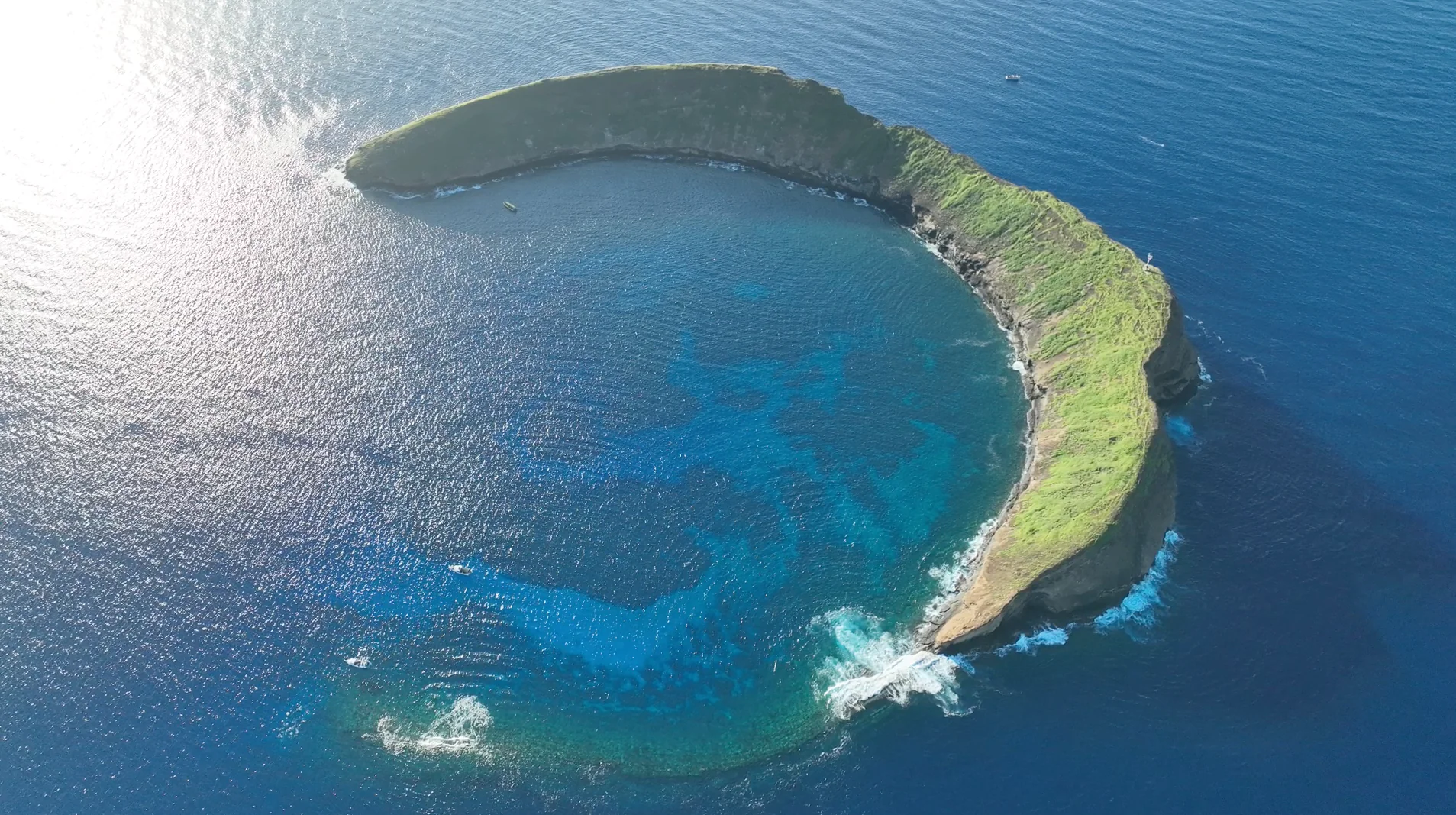 Friends of Molokini · Archive photograph
Records include dated historical species identifications and unresolved groups, some of which may overlap named records. This is neither a count of distinct currently accepted species nor a count of animals now living at Molokini.
Common and rare are not assigned from intuition or a single sighting. Where a study describes abundance, the wording is tied to that study and year. Otherwise the atlas states that present-day local frequency has not been quantified.
Local records reveal behaviors, relationships and visitors that a species name alone cannot tell.
Molokini’s 2024 shark-area assessment records Hawaiian cleaner wrasses cleaning gray reef sharks along the outer wall. The observation connects two animals through a shared reef relationship.
Photo-ID records place Molo1 at Molokini around 1999–2000 and Skinny Molo-Mini there in 2003–2005 and 2007. These are named individuals, not a count of the crater’s turtle population.
A juvenile whale shark was photographed on Molokini’s backside on 12 July 2018, according to DLNR. This dated encounter documents a visitor without implying a resident population.
Rice, cauliflower and lobe corals are animals, and all three appear in the 2007 Molokini outer-rim inventory. Each living colony belongs in the wildlife story.
The 31 May 2007 outer-rim appendix contains 69 invertebrate taxon records, including corals, worms, bryozoans and small crustaceans. Some were identified only to genus or family.
Wedge-tailed shearwaters nest in burrows on Molokini’s protected islet. Footsteps can collapse nesting burrows, making undisturbed ground part of seabird protection.
Acanthurus achilles
Historical Molokini survey recordView the record & factsRecorded in the Molokini column of the 31 May 2007 outer-rim survey. This confirms a historical local record, not current abundance or a guaranteed sighting.
How often? Present-day frequency not quantified
Name recorded in the source: Acanthurus achilles.
Source pages: Bishop Museum / Hawaiʻi Coral Reef Initiative · printed p. 57, PDF p. 67
Source detail. Bishop Museum Technical Report 39 (2008), Appendix C, printed p. 57 / PDF p. 67, rightmost Molokini column. Reconnaissance plus transect occurrence data; not a visit-frequency series.
Scientific name retained as reported in the historical survey; no complete modern taxonomic revision is claimed.
Link to this recordChromis agilis
Historical Molokini survey recordView the record & factsRecorded in the Molokini column of the 31 May 2007 outer-rim survey. This confirms a historical local record, not current abundance or a guaranteed sighting.
How often? Present-day frequency not quantified
Name recorded in the source: Chromis agilis.
Source pages: Bishop Museum / Hawaiʻi Coral Reef Initiative · printed p. 58, PDF p. 68
Source detail. Bishop Museum Technical Report 39 (2008), Appendix C, printed p. 58 / PDF p. 68, rightmost Molokini column. Reconnaissance plus transect occurrence data; not a visit-frequency series.
Scientific name retained as reported in the historical survey; no complete modern taxonomic revision is claimed.
Link to this recordPocillopora eydouxi
Historical Molokini survey recordView the record & factsRecorded in the Molokini column of the 31 May 2007 outer-rim survey. This confirms a historical local record, not current abundance or a guaranteed sighting.
How often? Present-day frequency not quantified
Name recorded in the source: Pocillopora eydouxi.
Source pages: Bishop Museum / Hawaiʻi Coral Reef Initiative · printed p. 55, PDF p. 65
Source detail. Bishop Museum Technical Report 39 (2008), Appendix C, printed p. 55 / PDF p. 65, rightmost Molokini column. Reconnaissance plus transect occurrence data; not a visit-frequency series.
Historical scientific name retained as reported. Taxonomic revisions or species-complex identifications require review before assigning a different modern species name.
Link to this recordParacirrhites arcatus
Historical Molokini survey recordView the record & factsRecorded in the Molokini column of the 31 May 2007 outer-rim survey. This confirms a historical local record, not current abundance or a guaranteed sighting. NOAA’s 2005 Molokini account also names it among the most numerous fish observed.
How often? Among the numerically most abundant fish in the 2005 Molokini survey; current frequency unquantified
Name recorded in the source: Paracirrhites arcatus.
Source pages: Bishop Museum / Hawaiʻi Coral Reef Initiative · printed p. 58, PDF p. 68; NOAA Pacific Islands Fisheries Science Center, Coral Reef Ecosystem Division · printed p. 15, PDF p. 15
Source detail. Bishop Museum Technical Report 39 (2008), Appendix C, printed p. 58 / PDF p. 68, rightmost Molokini column. Reconnaissance plus transect occurrence data; not a visit-frequency series.
Scientific name retained as reported in the historical survey; no complete modern taxonomic revision is claimed.
Link to this recordPanulirus marginatus
Historical Molokini survey recordView the record & factsRecorded in the Molokini column of the 31 May 2007 outer-rim survey. This confirms a historical local record, not current abundance or a guaranteed sighting.
How often? Present-day frequency not quantified
Name recorded in the source: Panulirus marginatus.
Source pages: Bishop Museum / Hawaiʻi Coral Reef Initiative · printed p. 56, PDF p. 66
Source detail. Bishop Museum Technical Report 39 (2008), Appendix C, printed p. 56 / PDF p. 66, rightmost Molokini column. Reconnaissance plus transect occurrence data; not a visit-frequency series.
Scientific name retained as reported in the historical survey; no complete modern taxonomic revision is claimed.
Link to this recordEchinothrix calamaris
Historical Molokini survey recordView the record & factsRecorded in the Molokini column of the 31 May 2007 outer-rim survey. This confirms a historical local record, not current abundance or a guaranteed sighting.
How often? Present-day frequency not quantified
Name recorded in the source: Echinothrix calamaris.
Source pages: Bishop Museum / Hawaiʻi Coral Reef Initiative · printed p. 56, PDF p. 66
Source detail. Bishop Museum Technical Report 39 (2008), Appendix C, printed p. 56 / PDF p. 66, rightmost Molokini column. Reconnaissance plus transect occurrence data; not a visit-frequency series.
Scientific name retained as reported in the historical survey; no complete modern taxonomic revision is claimed.
Link to this recordCantherhines dumerilii
Historical Molokini survey recordView the record & factsRecorded in the Molokini column of the 31 May 2007 outer-rim survey. This confirms a historical local record, not current abundance or a guaranteed sighting.
How often? Present-day frequency not quantified
Name recorded in the source: Cantherhines dumerilii.
Source pages: Bishop Museum / Hawaiʻi Coral Reef Initiative · printed p. 58, PDF p. 68
Source detail. Bishop Museum Technical Report 39 (2008), Appendix C, printed p. 58 / PDF p. 68, rightmost Molokini column. Reconnaissance plus transect occurrence data; not a visit-frequency series.
Scientific name retained as reported in the historical survey; no complete modern taxonomic revision is claimed.
Link to this recordStethojulis balteata
Historical Molokini survey recordView the record & factsPositive occurrence in DLNR’s July 1976 cove survey. Historical identification and timing are retained; no present-day frequency is inferred.
How often? Present-day frequency not quantified
Name recorded in the source: Stethojulis balteata.
Source pages: Hawaiʻi DLNR Division of Fish and Game · PDF p. 13
Source detail. Table 1, supplied reference 04 PDF p. 13. A positive estimated standing-crop value is recorded in at least one station. The Pūpūkea appendix is an independent name reference only, not evidence for Molokini occurrence.
Scientific identification is attributed to the cited source. Historical survey records are not a full modern taxonomic revision.
Link to this recordLeptastrea bewickensis
Historical Molokini survey recordView the record & factsRecorded in the Molokini column of the 31 May 2007 outer-rim survey. This confirms a historical local record, not current abundance or a guaranteed sighting.
How often? Present-day frequency not quantified
Name recorded in the source: Leptastrea bewickensis.
Source pages: Bishop Museum / Hawaiʻi Coral Reef Initiative · printed p. 55, PDF p. 65
Source detail. Bishop Museum Technical Report 39 (2008), Appendix C, printed p. 55 / PDF p. 65, rightmost Molokini column. Reconnaissance plus transect occurrence data; not a visit-frequency series.
Scientific name retained as reported in the historical survey; no complete modern taxonomic revision is claimed.
Link to this recordMonotaxis grandoculis
Historical Molokini survey recordView the record & factsRecorded in the Molokini column of the 31 May 2007 outer-rim survey. This confirms a historical local record, not current abundance or a guaranteed sighting.
How often? Present-day frequency not quantified
Name recorded in the source: Monotaxis grandoculis.
Source pages: Bishop Museum / Hawaiʻi Coral Reef Initiative · printed p. 58, PDF p. 68
Source detail. Bishop Museum Technical Report 39 (2008), Appendix C, printed p. 58 / PDF p. 68, rightmost Molokini column. Reconnaissance plus transect occurrence data; not a visit-frequency series.
Scientific name retained as reported in the historical survey; no complete modern taxonomic revision is claimed.
Link to this recordMyripristis berndti
Historical Molokini survey recordView the record & factsRecorded in the Molokini column of the 31 May 2007 outer-rim survey. This confirms a historical local record, not current abundance or a guaranteed sighting.
How often? Present-day frequency not quantified
Name recorded in the source: Myripristis berndti.
Source pages: Bishop Museum / Hawaiʻi Coral Reef Initiative · printed p. 58, PDF p. 68
Source detail. Bishop Museum Technical Report 39 (2008), Appendix C, printed p. 58 / PDF p. 68, rightmost Molokini column. Reconnaissance plus transect occurrence data; not a visit-frequency series.
Scientific name retained as reported in the historical survey; no complete modern taxonomic revision is claimed.
Link to this recordGomphosus varius
Historical Molokini survey recordView the record & factsRecorded in the Molokini column of the 31 May 2007 outer-rim survey. This confirms a historical local record, not current abundance or a guaranteed sighting.
How often? Present-day frequency not quantified
Name recorded in the source: Gomphosus varius.
Source pages: Bishop Museum / Hawaiʻi Coral Reef Initiative · printed p. 58, PDF p. 68
Source detail. Bishop Museum Technical Report 39 (2008), Appendix C, printed p. 58 / PDF p. 68, rightmost Molokini column. Reconnaissance plus transect occurrence data; not a visit-frequency series.
Scientific name retained as reported in the historical survey; no complete modern taxonomic revision is claimed.
Link to this recordLytocarpia niger
Historical Molokini survey recordView the record & factsRecorded in the Molokini column of the 31 May 2007 outer-rim survey. This confirms a historical local record, not current abundance or a guaranteed sighting.
How often? Present-day frequency not quantified
Name recorded in the source: Lytocarpia niger.
Source pages: Bishop Museum / Hawaiʻi Coral Reef Initiative · printed p. 57, PDF p. 67
Source detail. Bishop Museum Technical Report 39 (2008), Appendix C, printed p. 57 / PDF p. 67, rightmost Molokini column. Reconnaissance plus transect occurrence data; not a visit-frequency series.
Scientific name retained as reported in the historical survey; no complete modern taxonomic revision is claimed.
Link to this recordHolothuroidea (unidentified black sea cucumber)
Historical local descriptionView the record & factsThe 2009 guide describes black sea cucumbers in Molokini’s Mid Reef sand channel. A common-color description does not identify their species.
How often? Current local frequency not quantified
Name recorded in the source: Holothuroidea (unidentified black sea cucumber).
Source pages: Mālama Kai Foundation; hosted by Hawaiʻi DLNR DOBOR · printed p. 11, PDF p. 7
Source detail. Molokini zones, printed p. 11 / PDF p. 7. The old descriptive abundance is not imported as a current count.
This is not an additional confirmed named species. The record is retained at the taxonomic level the evidence can safely support.
Link to this recordMelichthys niger
Historical Molokini survey recordView the record & factsRecorded in the Molokini column of the 31 May 2007 outer-rim survey. This confirms a historical local record, not current abundance or a guaranteed sighting.
How often? Present-day frequency not quantified
Name recorded in the source: Melichthys niger.
Source pages: Bishop Museum / Hawaiʻi Coral Reef Initiative · printed p. 58, PDF p. 68
Source detail. Bishop Museum Technical Report 39 (2008), Appendix C, printed p. 58 / PDF p. 68, rightmost Molokini column. Reconnaissance plus transect occurrence data; not a visit-frequency series.
Scientific name retained as reported in the historical survey; no complete modern taxonomic revision is claimed.
Link to this recordPinctada margaritifera
Historical Molokini survey recordView the record & factsRecorded in the Molokini column of the 31 May 2007 outer-rim survey. This confirms a historical local record, not current abundance or a guaranteed sighting.
How often? Present-day frequency not quantified
Name recorded in the source: Pinctada margaritifera.
Source pages: Bishop Museum / Hawaiʻi Coral Reef Initiative · printed p. 55, PDF p. 65
Source detail. Bishop Museum Technical Report 39 (2008), Appendix C, printed p. 55 / PDF p. 65, rightmost Molokini column. Reconnaissance plus transect occurrence data; not a visit-frequency series.
Scientific name retained as reported in the historical survey; no complete modern taxonomic revision is claimed.
Link to this recordChromis vanderbilti
Historical Molokini survey recordView the record & factsRecorded in the Molokini column of the 31 May 2007 outer-rim survey. This confirms a historical local record, not current abundance or a guaranteed sighting. NOAA’s 2005 Molokini account also names it among the most numerous fish observed.
How often? Among the numerically most abundant fish in the 2005 Molokini survey; current frequency unquantified
Name recorded in the source: Chromis vanderbilti.
Source pages: Bishop Museum / Hawaiʻi Coral Reef Initiative · printed p. 58, PDF p. 68; NOAA Pacific Islands Fisheries Science Center, Coral Reef Ecosystem Division · printed p. 15, PDF p. 15
Source detail. Bishop Museum Technical Report 39 (2008), Appendix C, printed p. 58 / PDF p. 68, rightmost Molokini column. Reconnaissance plus transect occurrence data; not a visit-frequency series.
Scientific name retained as reported in the historical survey; no complete modern taxonomic revision is claimed.
Link to this recordCtenochaetus hawaiiensis
Historical Molokini survey recordView the record & factsRecorded in the Molokini column of the 31 May 2007 outer-rim survey. This confirms a historical local record, not current abundance or a guaranteed sighting.
How often? Present-day frequency not quantified
Name recorded in the source: Ctenochaetus hawaiiensis.
Source pages: Bishop Museum / Hawaiʻi Coral Reef Initiative · printed p. 58, PDF p. 68
Source detail. Bishop Museum Technical Report 39 (2008), Appendix C, printed p. 58 / PDF p. 68, rightmost Molokini column. Reconnaissance plus transect occurrence data; not a visit-frequency series.
Scientific name retained as reported in the historical survey; no complete modern taxonomic revision is claimed.
Link to this recordParacirrhites forsteri
Historical Molokini survey recordView the record & factsRecorded in the Molokini column of the 31 May 2007 outer-rim survey. This confirms a historical local record, not current abundance or a guaranteed sighting.
How often? Present-day frequency not quantified
Name recorded in the source: Paracirrhites forsteri.
Source pages: Bishop Museum / Hawaiʻi Coral Reef Initiative · printed p. 58, PDF p. 68
Source detail. Bishop Museum Technical Report 39 (2008), Appendix C, printed p. 58 / PDF p. 68, rightmost Molokini column. Reconnaissance plus transect occurrence data; not a visit-frequency series.
Scientific name retained as reported in the historical survey; no complete modern taxonomic revision is claimed.
Link to this recordAbudefduf sordidus
Historical Molokini survey recordView the record & factsRecorded in the Molokini column of the 31 May 2007 outer-rim survey. This confirms a historical local record, not current abundance or a guaranteed sighting.
How often? Present-day frequency not quantified
Name recorded in the source: Abudefduf sordidus.
Source pages: Bishop Museum / Hawaiʻi Coral Reef Initiative · printed p. 57, PDF p. 67
Source detail. Bishop Museum Technical Report 39 (2008), Appendix C, printed p. 57 / PDF p. 67, rightmost Molokini column. Reconnaissance plus transect occurrence data; not a visit-frequency series.
The source’s common-name label was corrected using an independent identification reference; the scientific occurrence record is unchanged.
Link to this recordLutjanus fulvus
Historical Molokini survey recordView the record & factsRecorded in the Molokini column of the 31 May 2007 outer-rim survey. This confirms a historical local record, not current abundance or a guaranteed sighting.
How often? Present-day frequency not quantified
Name recorded in the source: Lutjanus fulvus.
Source pages: Bishop Museum / Hawaiʻi Coral Reef Initiative · printed p. 58, PDF p. 68
Source detail. Bishop Museum Technical Report 39 (2008), Appendix C, printed p. 58 / PDF p. 68, rightmost Molokini column. Reconnaissance plus transect occurrence data; not a visit-frequency series.
Scientific name retained as reported in the historical survey; no complete modern taxonomic revision is claimed.
Link to this recordPteraeolidia ianthina
Historical Molokini survey recordView the record & factsRecorded in the Molokini column of the 31 May 2007 outer-rim survey. This confirms a historical local record, not current abundance or a guaranteed sighting.
How often? Present-day frequency not quantified
Name recorded in the source: Pteraeolidia ianthina.
Source pages: Bishop Museum / Hawaiʻi Coral Reef Initiative · printed p. 57, PDF p. 67
Source detail. Bishop Museum Technical Report 39 (2008), Appendix C, printed p. 57 / PDF p. 67, rightmost Molokini column. Reconnaissance plus transect occurrence data; not a visit-frequency series.
Historical scientific name retained as reported. Taxonomic revisions or species-complex identifications require review before assigning a different modern species name.
Link to this recordAnthelia edmondsoni
Historical Molokini survey recordView the record & factsRecorded in the Molokini column of the 31 May 2007 outer-rim survey. This confirms a historical local record, not current abundance or a guaranteed sighting.
How often? Present-day frequency not quantified
Name recorded in the source: Anthelia edmondsoni.
Source pages: Bishop Museum / Hawaiʻi Coral Reef Initiative · printed p. 55, PDF p. 65
Source detail. Bishop Museum Technical Report 39 (2008), Appendix C, printed p. 55 / PDF p. 65, rightmost Molokini column. Reconnaissance plus transect occurrence data; not a visit-frequency series.
Historical scientific name retained as reported. Taxonomic revisions or species-complex identifications require review before assigning a different modern species name.
Link to this recordEchinothrix diadema
Historical Molokini survey recordView the record & factsRecorded in the Molokini column of the 31 May 2007 outer-rim survey. This confirms a historical local record, not current abundance or a guaranteed sighting.
How often? Present-day frequency not quantified
Name recorded in the source: Echinothrix diadema.
Source pages: Bishop Museum / Hawaiʻi Coral Reef Initiative · printed p. 56, PDF p. 66
Source detail. Bishop Museum Technical Report 39 (2008), Appendix C, printed p. 56 / PDF p. 66, rightmost Molokini column. Reconnaissance plus transect occurrence data; not a visit-frequency series.
Scientific name retained as reported in the historical survey; no complete modern taxonomic revision is claimed.
Link to this recordPlectroglyphidodon johnstonianus
Historical Molokini survey recordView the record & factsRecorded in the Molokini column of the 31 May 2007 outer-rim survey. This confirms a historical local record, not current abundance or a guaranteed sighting.
How often? Present-day frequency not quantified
Name recorded in the source: Plectroglyphidodon johnstonianus.
Source pages: Bishop Museum / Hawaiʻi Coral Reef Initiative · printed p. 59, PDF p. 69
Source detail. Bishop Museum Technical Report 39 (2008), Appendix C, printed p. 59 / PDF p. 69, rightmost Molokini column. Reconnaissance plus transect occurrence data; not a visit-frequency series.
Scientific name retained as reported in the historical survey; no complete modern taxonomic revision is claimed.
Link to this recordPalythoa caesia
Historical Molokini survey recordView the record & factsRecorded in the Molokini column of the 31 May 2007 outer-rim survey. This confirms a historical local record, not current abundance or a guaranteed sighting.
How often? Present-day frequency not quantified
Name recorded in the source: Palythoa ceasia.
Source pages: Bishop Museum / Hawaiʻi Coral Reef Initiative · printed p. 55, PDF p. 65
Source detail. Bishop Museum Technical Report 39 (2008), Appendix C, printed p. 55 / PDF p. 65, rightmost Molokini column. Reconnaissance plus transect occurrence data; not a visit-frequency series.
The source prints “Palythoa ceasia”; the spelling is corrected to Palythoa caesia. This is an editorial spelling correction, not a new identification.
Link to this recordCaranx melampygus
Historical Molokini survey recordView the record & factsRecorded in the Molokini column of the 31 May 2007 outer-rim survey. This confirms a historical local record, not current abundance or a guaranteed sighting.
How often? Present-day frequency not quantified
Bluefin trevally were documented on Molokini’s outer rim in 2007. Later acoustic tracking followed their use of the protected crater as tourism fell during the pandemic and then returned.
In the study, tagged bluefin trevally used the sheltered interior more during the quiet period and were displaced from that habitat during busy morning hours after tourism resumed. This is evidence of movement and habitat use, not a count of fish born during the closure.
A sighting is most useful when it records where the fish was, the time, and surrounding activity. Repeated observations can help distinguish use of the inner cove from passage along the outer rim.
Name recorded in the source: Caranx melampygus.
Source pages: Bishop Museum / Hawaiʻi Coral Reef Initiative · printed p. 58, PDF p. 68
Source detail. Bishop Museum Technical Report 39 (2008), Appendix C, printed p. 58 / PDF p. 68, rightmost Molokini column. Reconnaissance plus transect occurrence data; not a visit-frequency series.
Scientific name retained as reported in the historical survey; no complete modern taxonomic revision is claimed.
Link to this recordLutjanus kasmira
Historical Molokini survey recordView the record & factsRecorded in the Molokini column of the 31 May 2007 outer-rim survey. This confirms a historical local record, not current abundance or a guaranteed sighting.
How often? Present-day frequency not quantified
Name recorded in the source: Lutjanus kasmira.
Source pages: Bishop Museum / Hawaiʻi Coral Reef Initiative · printed p. 58, PDF p. 68
Source detail. Bishop Museum Technical Report 39 (2008), Appendix C, printed p. 58 / PDF p. 68, rightmost Molokini column. Reconnaissance plus transect occurrence data; not a visit-frequency series.
Scientific name retained as reported in the historical survey; no complete modern taxonomic revision is claimed.
Link to this recordAcanthurus nigroris
Historical Molokini survey recordView the record & factsMarked present in the Molokini-only Appendix H for the 16–19 June 1976 field survey. No records from Papohaku Beach are used.
How often? Present-day frequency not quantified
Name recorded in the source: Acanthurus nigroris.
Source pages: University of Hawaiʻi Sea Grant / Marine Option Program; NOAA repository · printed p. 40, PDF p. 46
Source detail. Appendix H, printed p. 40, PDF p. 46. Positive presence mark and nonzero occurrence frequency in nine paired-diver transects (18 counting units). The Pūpūkea appendix is an independent name reference only, not evidence for Molokini occurrence.
Scientific identification is attributed to the cited source. Historical survey records are not a full modern taxonomic revision.
Link to this recordNaso unicornis
Historical Molokini survey recordView the record & factsRecorded in the Molokini column of the 31 May 2007 outer-rim survey. This confirms a historical local record, not current abundance or a guaranteed sighting.
How often? Present-day frequency not quantified
Name recorded in the source: Naso unicornis.
Source pages: Bishop Museum / Hawaiʻi Coral Reef Initiative · printed p. 58, PDF p. 68
Source detail. Bishop Museum Technical Report 39 (2008), Appendix C, printed p. 58 / PDF p. 68, rightmost Molokini column. Reconnaissance plus transect occurrence data; not a visit-frequency series.
Scientific name retained as reported in the historical survey; no complete modern taxonomic revision is claimed.
Link to this recordChaetodon fremblii
Historical Molokini survey recordView the record & factsPositive occurrence in DLNR’s July 1976 cove survey. Historical identification and timing are retained; no present-day frequency is inferred.
How often? Present-day frequency not quantified
Name recorded in the source: Chaetodon fremblii.
Source pages: Hawaiʻi DLNR Division of Fish and Game · PDF p. 13
Source detail. Table 1, supplied reference 04 PDF p. 13. A positive estimated standing-crop value is recorded in at least one station.
Scientific identification is attributed to the cited source. Historical survey records are not a full modern taxonomic revision.
Link to this recordAntipathes sp.
Historical Molokini survey recordView the record & factsRecorded in the Molokini column of the 31 May 2007 outer-rim survey. This confirms a historical local record, not current abundance or a guaranteed sighting.
How often? Present-day frequency not quantified
Name recorded in the source: Antipathes sp..
Source pages: Bishop Museum / Hawaiʻi Coral Reef Initiative · printed p. 55, PDF p. 65
Source detail. Bishop Museum Technical Report 39 (2008), Appendix C, printed p. 55 / PDF p. 65, rightmost Molokini column. Reconnaissance plus transect occurrence data; not a visit-frequency series.
The observation was not resolved confidently to a species; it must not be counted as an additional confirmed species or given species-specific traits.
Link to this recordPlectroglyphidodon imparipennis
Historical Molokini survey recordView the record & factsRecorded in the Molokini column of the 31 May 2007 outer-rim survey. This confirms a historical local record, not current abundance or a guaranteed sighting.
How often? Present-day frequency not quantified
Name recorded in the source: Plectroglyphidodon imparipennis.
Source pages: Bishop Museum / Hawaiʻi Coral Reef Initiative · printed p. 59, PDF p. 69
Source detail. Bishop Museum Technical Report 39 (2008), Appendix C, printed p. 59 / PDF p. 69, rightmost Molokini column. Reconnaissance plus transect occurrence data; not a visit-frequency series.
Scientific name retained as reported in the historical survey; no complete modern taxonomic revision is claimed.
Link to this recordDrupa (Ricinella) rubusidaeus
Historical Molokini survey recordView the record & factsRecorded in the Molokini column of the 31 May 2007 outer-rim survey. This confirms a historical local record, not current abundance or a guaranteed sighting.
How often? Present-day frequency not quantified
Name recorded in the source: Drupa (Ricinella) rubusidaeus.
Source pages: Bishop Museum / Hawaiʻi Coral Reef Initiative · printed p. 56, PDF p. 66
Source detail. Bishop Museum Technical Report 39 (2008), Appendix C, printed p. 56 / PDF p. 66, rightmost Molokini column. Reconnaissance plus transect occurrence data; not a visit-frequency series.
Scientific name retained as reported in the historical survey; no complete modern taxonomic revision is claimed.
Link to this recordKyphosus bigibbus
Historical Molokini survey recordView the record & factsMarked present in the Molokini-only Appendix H for the 16–19 June 1976 field survey. No records from Papohaku Beach are used.
How often? Present-day frequency not quantified
Name recorded in the source: Kyphosus bigibbus.
Source pages: University of Hawaiʻi Sea Grant / Marine Option Program; NOAA repository · printed p. 41, PDF p. 47
Source detail. Appendix H, printed p. 41, PDF p. 47. Positive presence mark and nonzero occurrence frequency in nine paired-diver transects (18 counting units).
Scientific identification is attributed to the cited source. Historical survey records are not a full modern taxonomic revision.
Link to this recordChlorurus sordidus
Historical Molokini survey recordView the record & factsRecorded in the Molokini column of the 31 May 2007 outer-rim survey. This confirms a historical local record, not current abundance or a guaranteed sighting.
How often? Present-day frequency not quantified
Name recorded in the source: Chlorurus sordidus.
Source pages: Bishop Museum / Hawaiʻi Coral Reef Initiative · printed p. 58, PDF p. 68
Source detail. Bishop Museum Technical Report 39 (2008), Appendix C, printed p. 58 / PDF p. 68, rightmost Molokini column. Reconnaissance plus transect occurrence data; not a visit-frequency series.
Historical scientific name retained as reported. Taxonomic revisions or species-complex identifications require review before assigning a different modern species name.
Link to this recordBulweria bulwerii
ʻOu
Agency-listed breeding occurrenceView the record & factsDOFAW lists Molokini among the main Hawaiian Island islets where Bulwer’s petrels breed.
How often? Present-day frequency not quantified
Molokini is among the breeding islets listed for ʻou by DOFAW. This small, dark seabird is highly pelagic and active at colonies at night, so a daytime view from the water is a poor census method.
Bulwer’s petrels nest in hollows and crevices and generally forage alone at sea. Their diet includes fish and squid. The agency describes long-term pairs and repeated use of nesting places. A confirmed breeding locality does not tell us how many pairs are present in the current season.
Name recorded in the source: Bulweria bulwerii.
Source detail. DOFAW species account, distribution section. A breeding-location record, not a recent nest census.
Scientific identification is attributed to the cited source. Historical survey records are not a full modern taxonomic revision.
Link to this recordPocillopora meandrina
Historical Molokini survey recordView the record & factsRecorded in the Molokini column of the 31 May 2007 outer-rim survey. This confirms a historical local record, not current abundance or a guaranteed sighting.
How often? Present-day frequency not quantified
Cauliflower coral has stout branches with wart-like surface projections. DAR associates it with wave-agitated environments. These structures provide a useful identification clue while reminding us how easily living reef surfaces can be contacted by fins or equipment.
The 2007 survey described abundant colonies on the southeast outer-rim cliff face and shelf. That observation is local and dated; it should not be converted into a current reef-condition grade.
Name recorded in the source: Pocillopora meandrina.
Source pages: Bishop Museum / Hawaiʻi Coral Reef Initiative · printed p. 55, PDF p. 65
Source detail. Bishop Museum Technical Report 39 (2008), Appendix C, printed p. 55 / PDF p. 65, rightmost Molokini column. Reconnaissance plus transect occurrence data; not a visit-frequency series.
Scientific name retained as reported in the historical survey; no complete modern taxonomic revision is claimed.
Link to this recordAulostomus chinensis
Historical Molokini survey recordView the record & factsPositive occurrence in DLNR’s July 1976 cove survey. Historical identification and timing are retained; no present-day frequency is inferred.
How often? Present-day frequency not quantified
Name recorded in the source: Aulostomus chinensis.
Source pages: Hawaiʻi DLNR Division of Fish and Game · PDF p. 12
Source detail. Table 1, supplied reference 04 PDF p. 12. A positive estimated standing-crop value is recorded in at least one station. The Pūpūkea appendix is an independent name reference only, not evidence for Molokini occurrence.
Scientific identification is attributed to the cited source. Historical survey records are not a full modern taxonomic revision.
Link to this recordChromis hanui
Historical Molokini survey recordView the record & factsRecorded in the Molokini column of the 31 May 2007 outer-rim survey. This confirms a historical local record, not current abundance or a guaranteed sighting.
How often? Present-day frequency not quantified
Name recorded in the source: Chromis hanui.
Source pages: Bishop Museum / Hawaiʻi Coral Reef Initiative · printed p. 58, PDF p. 68
Source detail. Bishop Museum Technical Report 39 (2008), Appendix C, printed p. 58 / PDF p. 68, rightmost Molokini column. Reconnaissance plus transect occurrence data; not a visit-frequency series.
Scientific name retained as reported in the historical survey; no complete modern taxonomic revision is claimed.
Link to this recordPennaria disticha
Historical Molokini survey recordView the record & factsRecorded in the Molokini column of the 31 May 2007 outer-rim survey. This confirms a historical local record, not current abundance or a guaranteed sighting.
How often? Present-day frequency not quantified
Name recorded in the source: Pennaria disticha.
Source pages: Bishop Museum / Hawaiʻi Coral Reef Initiative · printed p. 57, PDF p. 67
Source detail. Bishop Museum Technical Report 39 (2008), Appendix C, printed p. 57 / PDF p. 67, rightmost Molokini column. Reconnaissance plus transect occurrence data; not a visit-frequency series.
Scientific name retained as reported in the historical survey; no complete modern taxonomic revision is claimed.
Link to this recordThalassoma trilobatum
Historical Molokini survey recordView the record & factsRecorded in the Molokini column of the 31 May 2007 outer-rim survey. This confirms a historical local record, not current abundance or a guaranteed sighting.
How often? Present-day frequency not quantified
Name recorded in the source: Thalassoma trilobatum.
Source pages: Bishop Museum / Hawaiʻi Coral Reef Initiative · printed p. 59, PDF p. 69
Source detail. Bishop Museum Technical Report 39 (2008), Appendix C, printed p. 59 / PDF p. 69, rightmost Molokini column. Reconnaissance plus transect occurrence data; not a visit-frequency series.
Scientific name retained as reported in the historical survey; no complete modern taxonomic revision is claimed.
Link to this recordSpirobranchus giganteus
Historical Molokini survey recordView the record & factsRecorded in the Molokini column of the 31 May 2007 outer-rim survey. This confirms a historical local record, not current abundance or a guaranteed sighting.
How often? Present-day frequency not quantified
Name recorded in the source: Spirobranchus giganteus.
Source pages: Bishop Museum / Hawaiʻi Coral Reef Initiative · printed p. 57, PDF p. 67
Source detail. Bishop Museum Technical Report 39 (2008), Appendix C, printed p. 57 / PDF p. 67, rightmost Molokini column. Reconnaissance plus transect occurrence data; not a visit-frequency series.
Historical scientific name retained as reported. Taxonomic revisions or species-complex identifications require review before assigning a different modern species name.
Link to this recordKyphosus sp.
Historical Molokini survey recordView the record & factsRecorded in the Molokini column of the 31 May 2007 outer-rim survey. This confirms a historical local record, not current abundance or a guaranteed sighting.
How often? Present-day frequency not quantified
Name recorded in the source: Kyphosus sp..
Source pages: Bishop Museum / Hawaiʻi Coral Reef Initiative · printed p. 58, PDF p. 68
Source detail. Bishop Museum Technical Report 39 (2008), Appendix C, printed p. 58 / PDF p. 68, rightmost Molokini column. Reconnaissance plus transect occurrence data; not a visit-frequency series.
The observation was not resolved confidently to a species; it must not be counted as an additional confirmed species or given species-specific traits.
Link to this recordCheilio inermis
Historical Molokini survey recordView the record & factsMarked present in the Molokini-only Appendix H for the 16–19 June 1976 field survey. No records from Papohaku Beach are used.
How often? Present-day frequency not quantified
Name recorded in the source: Cheilio inermis.
Source pages: University of Hawaiʻi Sea Grant / Marine Option Program; NOAA repository · printed p. 41, PDF p. 47
Source detail. Appendix H, printed p. 41, PDF p. 47. Positive presence mark and nonzero occurrence frequency in nine paired-diver transects (18 counting units).
Scientific identification is attributed to the cited source. Historical survey records are not a full modern taxonomic revision.
Link to this recordLabroides phthirophagus
Historical Molokini survey recordView the record & factsRecorded in the Molokini column of the 31 May 2007 outer-rim survey. This confirms a historical local record, not current abundance or a guaranteed sighting.
How often? Present-day frequency not quantified
Hawaiian cleaner wrasses maintain locations where other fish pause to be cleaned. Clients may hold their fins open or spread their gill covers. The cleaner removes external parasites and also feeds on mucus and some scales. Observing the interaction reveals ecological work that a species count alone cannot show.
Waikīkī Aquarium identifies this wrasse as Hawaiian endemic. It shelters at night in a mucus cocoon rather than burying itself in sand like many small wrasses. Molokini records appear in the 1976 surveys and the 2007 outer-rim inventory.
The Molokini shark-area assessment reports Hawaiian cleaner wrasses cleaning gray reef sharks on the outer wall. This is a locally documented example of the relationships that connect the atlas’s individual animal entries.
Name recorded in the source: Labroides phthirophagus.
Source pages: Bishop Museum / Hawaiʻi Coral Reef Initiative · printed p. 58, PDF p. 68; IUCN SSC Shark Specialist Group — Important Shark and Ray Areas · PDF p. 3
Source detail. Bishop Museum Technical Report 39 (2008), Appendix C, printed p. 58 / PDF p. 68, rightmost Molokini column. Reconnaissance plus transect occurrence data; not a visit-frequency series.
Scientific name retained as reported in the historical survey; no complete modern taxonomic revision is claimed.
Link to this recordSpondylus violacescens
Historical Molokini survey recordView the record & factsRecorded in the Molokini column of the 31 May 2007 outer-rim survey. This confirms a historical local record, not current abundance or a guaranteed sighting.
How often? Present-day frequency not quantified
Name recorded in the source: Spondylus violacescens.
Source pages: Bishop Museum / Hawaiʻi Coral Reef Initiative · printed p. 55, PDF p. 65
Source detail. Bishop Museum Technical Report 39 (2008), Appendix C, printed p. 55 / PDF p. 65, rightmost Molokini column. Reconnaissance plus transect occurrence data; not a visit-frequency series.
Scientific name retained as reported in the historical survey; no complete modern taxonomic revision is claimed.
Link to this recordTripneustes gratilla
Historical Molokini survey recordView the record & factsRecorded in the Molokini column of the 31 May 2007 outer-rim survey. This confirms a historical local record, not current abundance or a guaranteed sighting.
How often? Present-day frequency not quantified
Name recorded in the source: Tripneustes gratilla.
Source pages: Bishop Museum / Hawaiʻi Coral Reef Initiative · printed p. 56, PDF p. 66
Source detail. Bishop Museum Technical Report 39 (2008), Appendix C, printed p. 56 / PDF p. 66, rightmost Molokini column. Reconnaissance plus transect occurrence data; not a visit-frequency series.
Scientific name retained as reported in the historical survey; no complete modern taxonomic revision is claimed.
Link to this recordCirrhipathes anguina
Historical Molokini survey recordView the record & factsRecorded in the Molokini column of the 31 May 2007 outer-rim survey. This confirms a historical local record, not current abundance or a guaranteed sighting.
How often? Present-day frequency not quantified
Name recorded in the source: Cirrhipathes anguina.
Source pages: Bishop Museum / Hawaiʻi Coral Reef Initiative · printed p. 55, PDF p. 65
Source detail. Bishop Museum Technical Report 39 (2008), Appendix C, printed p. 55 / PDF p. 65, rightmost Molokini column. Reconnaissance plus transect occurrence data; not a visit-frequency series.
Scientific name retained as reported in the historical survey; no complete modern taxonomic revision is claimed.
Link to this recordAcanthurus triostegus
Historical Molokini survey recordView the record & factsMarked present in the Molokini-only Appendix H for the 16–19 June 1976 field survey. No records from Papohaku Beach are used.
How often? Present-day frequency not quantified
Name recorded in the source: Acanthurus triostegus.
Source pages: University of Hawaiʻi Sea Grant / Marine Option Program; NOAA repository · printed p. 40, PDF p. 46
Source detail. Appendix H, printed p. 40, PDF p. 46. Positive presence mark and nonzero occurrence frequency in nine paired-diver transects (18 counting units). The Pūpūkea appendix is an independent name reference only, not evidence for Molokini occurrence.
Retained as the 1976 identification. Hawaiian convict-surgeonfish taxonomy has been revised; this historical record has not been reidentified from a specimen and is not silently assigned to a modern split species.
Link to this recordTrapezia sp.
Historical Molokini survey recordView the record & factsRecorded in the Molokini column of the 31 May 2007 outer-rim survey. This confirms a historical local record, not current abundance or a guaranteed sighting.
How often? Present-day frequency not quantified
Name recorded in the source: Trapezia sp..
Source pages: Bishop Museum / Hawaiʻi Coral Reef Initiative · printed p. 56, PDF p. 66
Source detail. Bishop Museum Technical Report 39 (2008), Appendix C, printed p. 56 / PDF p. 66, rightmost Molokini column. Reconnaissance plus transect occurrence data; not a visit-frequency series.
The observation was not resolved confidently to a species; it must not be counted as an additional confirmed species or given species-specific traits.
Link to this recordPavona varians
Historical Molokini survey recordView the record & factsRecorded in the Molokini column of the 31 May 2007 outer-rim survey. This confirms a historical local record, not current abundance or a guaranteed sighting.
How often? Present-day frequency not quantified
Name recorded in the source: Pavona varians.
Source pages: Bishop Museum / Hawaiʻi Coral Reef Initiative · printed p. 55, PDF p. 65
Source detail. Bishop Museum Technical Report 39 (2008), Appendix C, printed p. 55 / PDF p. 65, rightmost Molokini column. Reconnaissance plus transect occurrence data; not a visit-frequency series.
Scientific name retained as reported in the historical survey; no complete modern taxonomic revision is claimed.
Link to this recordPseudocheilinus evanidus
Historical Molokini survey recordView the record & factsExplicitly named for Molokini in NOAA’s 2005 fish rapid-ecological-assessment report.
How often? Among the numerically most abundant fish in the 2005 Molokini survey
Name recorded in the source: Pseudocheilinus evanidus.
Source pages: NOAA Pacific Islands Fisheries Science Center, Coral Reef Ecosystem Division · printed p. 15, PDF p. 15
Source detail. Appendix A, printed/PDF p. 15; Molokini section or Molokini-only observations list. Three stations during the cruise’s second leg.
Scientific identification is attributed to the cited source. Historical survey records are not a full modern taxonomic revision.
Link to this recordParupeneus bifasciatus
Historical Molokini survey recordView the record & factsPositive occurrence in DLNR’s July 1976 cove survey. Historical identification and timing are retained; no present-day frequency is inferred.
How often? Present-day frequency not quantified
Name recorded in the source: Parupeneus bifasciatus.
Source pages: Hawaiʻi DLNR Division of Fish and Game · PDF p. 13
Source detail. Table 1, supplied reference 04 PDF p. 13. A positive estimated standing-crop value is recorded in at least one station.
Scientific identification is attributed to the cited source. Historical survey records are not a full modern taxonomic revision.
Link to this recordScomberoides lysan
Historical Molokini survey recordView the record & factsMarked present in the Molokini-only Appendix H for the 16–19 June 1976 field survey. No records from Papohaku Beach are used.
How often? Present-day frequency not quantified
Name recorded in the source: Scomberoides lysan.
Source pages: University of Hawaiʻi Sea Grant / Marine Option Program; NOAA repository · printed p. 40, PDF p. 46
Source detail. Appendix H, printed p. 40, PDF p. 46. Positive presence mark and nonzero occurrence frequency in nine paired-diver transects (18 counting units). The Pūpūkea appendix is an independent name reference only, not evidence for Molokini occurrence.
Scientific identification is attributed to the cited source. Historical survey records are not a full modern taxonomic revision.
Link to this recordDynomene sp.
Historical Molokini survey recordView the record & factsRecorded in the Molokini column of the 31 May 2007 outer-rim survey. This confirms a historical local record, not current abundance or a guaranteed sighting.
How often? Present-day frequency not quantified
Name recorded in the source: Dynomene sp..
Source pages: Bishop Museum / Hawaiʻi Coral Reef Initiative · printed p. 56, PDF p. 66
Source detail. Bishop Museum Technical Report 39 (2008), Appendix C, printed p. 56 / PDF p. 66, rightmost Molokini column. Reconnaissance plus transect occurrence data; not a visit-frequency series.
The observation was not resolved confidently to a species; it must not be counted as an additional confirmed species or given species-specific traits.
Link to this recordPseudocheilinus octotaenia
Historical Molokini survey recordView the record & factsRecorded in the Molokini column of the 31 May 2007 outer-rim survey. This confirms a historical local record, not current abundance or a guaranteed sighting.
How often? Present-day frequency not quantified
Name recorded in the source: Pseudocheilinus octotaenia.
Source pages: Bishop Museum / Hawaiʻi Coral Reef Initiative · printed p. 59, PDF p. 69
Source detail. Bishop Museum Technical Report 39 (2008), Appendix C, printed p. 59 / PDF p. 69, rightmost Molokini column. Reconnaissance plus transect occurrence data; not a visit-frequency series.
Scientific name retained as reported in the historical survey; no complete modern taxonomic revision is claimed.
Link to this recordCoris venusta
Historical Molokini survey recordView the record & factsPositive occurrence in DLNR’s July 1976 cove survey. Historical identification and timing are retained; no present-day frequency is inferred.
How often? Present-day frequency not quantified
Name recorded in the source: Coris venusta.
Source pages: Hawaiʻi DLNR Division of Fish and Game · PDF p. 13
Source detail. Table 1, supplied reference 04 PDF p. 13. A positive estimated standing-crop value is recorded in at least one station. The Pūpūkea appendix is an independent name reference only, not evidence for Molokini occurrence.
Scientific identification is attributed to the cited source. Historical survey records are not a full modern taxonomic revision.
Link to this recordAcanthurus mata
Historical Molokini survey recordView the record & factsPositive occurrence in DLNR’s July 1976 cove survey. Historical identification and timing are retained; no present-day frequency is inferred.
How often? Present-day frequency not quantified
Name recorded in the source: Acanthurus mata.
Source pages: Hawaiʻi DLNR Division of Fish and Game · PDF p. 13
Source detail. Table 1, supplied reference 04 PDF p. 13. A positive estimated standing-crop value is recorded in at least one station.
Scientific identification is attributed to the cited source. Historical survey records are not a full modern taxonomic revision.
Link to this recordAcanthurus dussumieri
Historical Molokini survey recordView the record & factsPositive occurrence in DLNR’s July 1976 cove survey. Historical identification and timing are retained; no present-day frequency is inferred.
How often? Present-day frequency not quantified
Name recorded in the source: Acanthurus dussumieri.
Source pages: Hawaiʻi DLNR Division of Fish and Game · PDF p. 13
Source detail. Table 1, supplied reference 04 PDF p. 13. A positive estimated standing-crop value is recorded in at least one station. The Pūpūkea appendix is an independent name reference only, not evidence for Molokini occurrence.
Scientific identification is attributed to the cited source. Historical survey records are not a full modern taxonomic revision.
Link to this recordPervagor spilosoma
Historical Molokini survey recordView the record & factsPositive occurrence in DLNR’s July 1976 cove survey. Historical identification and timing are retained; no present-day frequency is inferred.
How often? Present-day frequency not quantified
Name recorded in the source: Pervagor spilosoma.
Source pages: Hawaiʻi DLNR Division of Fish and Game · PDF p. 13
Source detail. Table 1, supplied reference 04 PDF p. 13. A positive estimated standing-crop value is recorded in at least one station.
Scientific identification is attributed to the cited source. Historical survey records are not a full modern taxonomic revision.
Link to this recordGymnangium hians
Historical Molokini survey recordView the record & factsRecorded in the Molokini column of the 31 May 2007 outer-rim survey. This confirms a historical local record, not current abundance or a guaranteed sighting.
How often? Present-day frequency not quantified
Name recorded in the source: Gymnangium hians.
Source pages: Bishop Museum / Hawaiʻi Coral Reef Initiative · printed p. 57, PDF p. 67
Source detail. Bishop Museum Technical Report 39 (2008), Appendix C, printed p. 57 / PDF p. 67, rightmost Molokini column. Reconnaissance plus transect occurrence data; not a visit-frequency series.
Scientific name retained as reported in the historical survey; no complete modern taxonomic revision is claimed.
Link to this recordCentropyge fisheri
Historical Molokini survey recordView the record & factsExplicitly named for Molokini in NOAA’s 2005 fish rapid-ecological-assessment report.
How often? Described as exceptionally abundant below 25 ft in the 2005 survey
Name recorded in the source: Centropyge fisheri.
Source pages: NOAA Pacific Islands Fisheries Science Center, Coral Reef Ecosystem Division · printed p. 15, PDF p. 15
Source detail. Appendix A, printed/PDF p. 15; Molokini section or Molokini-only observations list. Three stations during the cruise’s second leg.
Scientific identification is attributed to the cited source. Historical survey records are not a full modern taxonomic revision.
Link to this recordForcipiger flavissimus
Historical Molokini survey recordView the record & factsRecorded in the Molokini column of the 31 May 2007 outer-rim survey. This confirms a historical local record, not current abundance or a guaranteed sighting.
How often? Present-day frequency not quantified
Name recorded in the source: Forcipiger flavissimus.
Source pages: Bishop Museum / Hawaiʻi Coral Reef Initiative · printed p. 58, PDF p. 68
Source detail. Bishop Museum Technical Report 39 (2008), Appendix C, printed p. 58 / PDF p. 68, rightmost Molokini column. Reconnaissance plus transect occurrence data; not a visit-frequency series.
Scientific name retained as reported in the historical survey; no complete modern taxonomic revision is claimed.
Link to this recordChaetodon quadrimaculatus
Historical Molokini survey recordView the record & factsRecorded in the Molokini column of the 31 May 2007 outer-rim survey. This confirms a historical local record, not current abundance or a guaranteed sighting.
How often? Present-day frequency not quantified
Name recorded in the source: Chaetodon quadrimaculatus.
Source pages: Bishop Museum / Hawaiʻi Coral Reef Initiative · printed p. 58, PDF p. 68
Source detail. Bishop Museum Technical Report 39 (2008), Appendix C, printed p. 58 / PDF p. 68, rightmost Molokini column. Reconnaissance plus transect occurrence data; not a visit-frequency series.
Scientific name retained as reported in the historical survey; no complete modern taxonomic revision is claimed.
Link to this recordCaranx ignobilis
Historical Molokini survey recordView the record & factsExplicitly named for Molokini in NOAA’s 2005 fish rapid-ecological-assessment report.
How often? Present-day frequency not quantified
NOAA observers recorded giant trevally at Molokini in 2005 outside their belt transects. In later research, giant trevally helped drive the higher biomass measured during the 2020 tourism interruption. A few large predators can strongly influence total fish mass.
An off-transect encounter establishes local presence but cannot be treated as a transect density. The atlas keeps that distinction visible so a memorable large fish is not turned into an unsupported population estimate.
Name recorded in the source: Caranx ignobilis.
Source pages: NOAA Pacific Islands Fisheries Science Center, Coral Reef Ecosystem Division · printed p. 15, PDF p. 15
Source detail. Appendix A, printed/PDF p. 15; Molokini section or Molokini-only observations list. Three stations during the cruise’s second leg.
Scientific identification is attributed to the cited source. Historical survey records are not a full modern taxonomic revision.
Link to this recordXanthichthys auromarginatus
Historical Molokini survey recordView the record & factsRecorded in the Molokini column of the 31 May 2007 outer-rim survey. This confirms a historical local record, not current abundance or a guaranteed sighting. NOAA’s 2005 Molokini account also names it among the most numerous fish observed.
How often? Among the numerically most abundant fish in the 2005 Molokini survey; current frequency unquantified
Name recorded in the source: Xanthichthys auromarginatus.
Source pages: Bishop Museum / Hawaiʻi Coral Reef Initiative · printed p. 59, PDF p. 69; NOAA Pacific Islands Fisheries Science Center, Coral Reef Ecosystem Division · printed p. 15, PDF p. 15
Source detail. Bishop Museum Technical Report 39 (2008), Appendix C, printed p. 59 / PDF p. 69, rightmost Molokini column. Reconnaissance plus transect occurrence data; not a visit-frequency series.
Scientific name retained as reported in the historical survey; no complete modern taxonomic revision is claimed.
Link to this recordGlycera tesselata
Historical Molokini survey recordView the record & factsRecorded in the Molokini column of the 31 May 2007 outer-rim survey. This confirms a historical local record, not current abundance or a guaranteed sighting.
How often? Present-day frequency not quantified
Name recorded in the source: Glycera tesselata.
Source pages: Bishop Museum / Hawaiʻi Coral Reef Initiative · printed p. 57, PDF p. 67
Source detail. Bishop Museum Technical Report 39 (2008), Appendix C, printed p. 57 / PDF p. 67, rightmost Molokini column. Reconnaissance plus transect occurrence data; not a visit-frequency series.
Scientific name retained as reported in the historical survey; no complete modern taxonomic revision is claimed.
Link to this recordCtenochaetus strigosus
Historical Molokini survey recordView the record & factsRecorded in the Molokini column of the 31 May 2007 outer-rim survey. This confirms a historical local record, not current abundance or a guaranteed sighting.
How often? Present-day frequency not quantified
Name recorded in the source: Ctenochaetus strigosus.
Source pages: Bishop Museum / Hawaiʻi Coral Reef Initiative · printed p. 58, PDF p. 68
Source detail. Bishop Museum Technical Report 39 (2008), Appendix C, printed p. 58 / PDF p. 68, rightmost Molokini column. Reconnaissance plus transect occurrence data; not a visit-frequency series.
Scientific name retained as reported in the historical survey; no complete modern taxonomic revision is claimed.
Link to this recordCarcharhinus amblyrhynchos
Repeated observations in scientific area assessmentView the record & factsThe Molokini ISRA assessment identifies regular gray reef shark occurrence and seasonal observations of young sharks, based on diver records reported in 2024.
How often? Regular occurrence reported in the 2024 assessment; no current standardized rate
The shark-area assessment describes young gray reef sharks particularly during June–September and identifies Molokini as reproductive habitat. Its evidence comes from recreational observations compiled in 2024.
The assessment highlights a place of biological importance. It is not a new legal boundary, a guarantee of visible sharks, or a standardized estimate of their population.
The Molokini shark-area assessment reports Hawaiian cleaner wrasses cleaning gray reef sharks on the outer wall. This is a locally documented example of the relationships that connect the atlas’s individual animal entries.
Name recorded in the source: Carcharhinus amblyrhynchos.
Source pages: IUCN SSC Shark Specialist Group — Important Shark and Ray Areas · PDF p. 2; IUCN SSC Shark Specialist Group — Important Shark and Ray Areas · PDF p. 3; Mālama Kai Foundation; hosted by Hawaiʻi DLNR DOBOR · printed p. 11, PDF p. 7; IUCN SSC Shark Specialist Group — Important Shark and Ray Areas · PDF p. 3
Source detail. Assessment pp. 2–3; recreational observations had uneven effort across years and do not provide a standardized present-day sighting probability. Also described in the 2009 Molokini mooring guide; descriptive corroboration, not a quantitative survey.
Scientific identification is attributed to the cited source. Historical survey records are not a full modern taxonomic revision.
Link to this recordSphyraena barracuda
Historical Molokini survey recordView the record & factsExplicitly named for Molokini in NOAA’s 2005 fish rapid-ecological-assessment report. It was recorded only at Molokini among islands visited on that cruise; this does not mean it is endemic or globally rare.
How often? Notable in the 2005 cruise; present-day rarity not quantified
Name recorded in the source: Sphyraena barracuda.
Source pages: NOAA Pacific Islands Fisheries Science Center, Coral Reef Ecosystem Division · printed p. 16, PDF p. 16
Source detail. Appendix A, printed/PDF p. 16; Molokini section or Molokini-only observations list. Three stations during the cruise’s second leg.
Scientific identification is attributed to the cited source. Historical survey records are not a full modern taxonomic revision.
Link to this recordFregata minor
ʻIwa
Agency-confirmed aerial visitorView the record & factsDLNR describes great frigatebirds often soaring over Molokini. This is not evidence of a breeding colony there.
How often? Often observed soaring in the agency site account
DOFAW describes ʻiwa often soaring over Molokini. Its long wings, deeply forked tail and extended gliding flight make the airspace over the reef part of the wildlife experience. The agency account does not establish a Molokini breeding colony.
Frigatebirds sometimes take food from other seabirds, but they capture most of their own prey. In Hawaiʻi, flyingfish and squid are prominent foods. They take prey while on the wing and may join mixed feeding flocks above predatory fish.
Name recorded in the source: Fregata minor.
Source detail. DOFAW Molokini sanctuary account; DOFAW species account distinguishes main-island roosting from breeding.
Scientific identification is attributed to the cited source. Historical survey records are not a full modern taxonomic revision.
Link to this recordDynamena moluccana
Historical Molokini survey recordView the record & factsRecorded in the Molokini column of the 31 May 2007 outer-rim survey. This confirms a historical local record, not current abundance or a guaranteed sighting.
How often? Present-day frequency not quantified
Name recorded in the source: Dynamena moluccana.
Source pages: Bishop Museum / Hawaiʻi Coral Reef Initiative · printed p. 56, PDF p. 66
Source detail. Bishop Museum Technical Report 39 (2008), Appendix C, printed p. 56 / PDF p. 66, rightmost Molokini column. Reconnaissance plus transect occurrence data; not a visit-frequency series.
Scientific name retained as reported in the historical survey; no complete modern taxonomic revision is claimed.
Link to this recordTridentata borneensis
Historical Molokini survey recordView the record & factsRecorded in the Molokini column of the 31 May 2007 outer-rim survey. This confirms a historical local record, not current abundance or a guaranteed sighting.
How often? Present-day frequency not quantified
Name recorded in the source: Tridentata borneensis.
Source pages: Bishop Museum / Hawaiʻi Coral Reef Initiative · printed p. 57, PDF p. 67
Source detail. Bishop Museum Technical Report 39 (2008), Appendix C, printed p. 57 / PDF p. 67, rightmost Molokini column. Reconnaissance plus transect occurrence data; not a visit-frequency series.
Scientific name retained as reported in the historical survey; no complete modern taxonomic revision is claimed.
Link to this recordAprion virescens
Historical Molokini survey recordView the record & factsMarked present in the Molokini-only Appendix H for the 16–19 June 1976 field survey. No records from Papohaku Beach are used.
How often? Present-day frequency not quantified
Name recorded in the source: Aprion virescens.
Source pages: University of Hawaiʻi Sea Grant / Marine Option Program; NOAA repository · printed p. 41, PDF p. 47
Source detail. Appendix H, printed p. 41, PDF p. 47. Positive presence mark and nonzero occurrence frequency in nine paired-diver transects (18 counting units). The Pūpūkea appendix is an independent name reference only, not evidence for Molokini occurrence.
Scientific identification is attributed to the cited source. Historical survey records are not a full modern taxonomic revision.
Link to this recordChelonia mydas
Honu
Historical literature reportView the record & factsThe 2010 Molokini recreation report includes green turtles in its environmental review. It provides no site-specific turtle census or dated photo-ID records.
How often? Current local frequency not established by the reviewed evidence
Name recorded in the source: Chelonia mydas.
Source pages: Brian Szuster and Mark Needham / University of Hawaiʻi and Oregon State University · printed p. 32
Source detail. Chapter 3.4, printed p. 32. Treat the report’s broad abundance wording as historical; the atlas does not label green turtles common at the crater today.
Scientific identification is attributed to the cited source. Historical survey records are not a full modern taxonomic revision.
Link to this recordArothron meleagris
Historical Molokini survey recordView the record & factsMarked present in the Molokini-only Appendix H for the 16–19 June 1976 field survey. No records from Papohaku Beach are used.
How often? Present-day frequency not quantified
Name recorded in the source: Arothron meleagris.
Source pages: University of Hawaiʻi Sea Grant / Marine Option Program; NOAA repository · printed p. 41, PDF p. 47
Source detail. Appendix H, printed p. 41, PDF p. 47. Positive presence mark and nonzero occurrence frequency in nine paired-diver transects (18 counting units).
Scientific identification is attributed to the cited source. Historical survey records are not a full modern taxonomic revision.
Link to this recordDascyllus albisella
Historical Molokini survey recordView the record & factsRecorded in the Molokini column of the 31 May 2007 outer-rim survey. This confirms a historical local record, not current abundance or a guaranteed sighting.
How often? Present-day frequency not quantified
Name recorded in the source: Dascyllus albisella.
Source pages: Bishop Museum / Hawaiʻi Coral Reef Initiative · printed p. 58, PDF p. 68
Source detail. Bishop Museum Technical Report 39 (2008), Appendix C, printed p. 58 / PDF p. 68, rightmost Molokini column. Reconnaissance plus transect occurrence data; not a visit-frequency series.
Scientific name retained as reported in the historical survey; no complete modern taxonomic revision is claimed.
Link to this recordNeomonachus schauinslandi
Official local habitat-use recordView the record & factsNOAA’s critical-habitat rule identifies Molokini Crater as Maui Nui terrestrial habitat segment MAi1.
How often? Present-day frequency not quantified
Molokini appears explicitly in NOAA’s 2015 Hawaiian monk seal critical-habitat rule. That matters because protection extends beyond what a camera sees underwater: resting places on shore can be important parts of a marine animal’s habitat.
Monk seals take a varied diet including fish, eels, octopuses and crustaceans. NOAA describes much of their feeding as occurring near the bottom, including prey hidden in sand or beneath rocks. They are generally solitary and come ashore to rest and molt.
An official habitat segment establishes conservation importance. It supplies neither a current number of seals at Molokini nor a probability of seeing one.
Name recorded in the source: Neomonachus schauinslandi.
Source pages: NOAA National Marine Fisheries Service / Federal Register · PDF p. 148
Source detail. 2015 critical-habitat final rule, Table 1, PDF p. 148, with Maui Nui habitat explanation p. 144. This identifies important habitat, not a current seal count.
Scientific identification is attributed to the cited source. Historical survey records are not a full modern taxonomic revision.
Link to this recordPlectroglyphidodon sindonis
Historical Molokini survey recordView the record & factsRecorded in the Molokini column of the 31 May 2007 outer-rim survey. This confirms a historical local record, not current abundance or a guaranteed sighting.
How often? Present-day frequency not quantified
Name recorded in the source: Plectroglyphidodon sindonis.
Source pages: Bishop Museum / Hawaiʻi Coral Reef Initiative · printed p. 59, PDF p. 69
Source detail. Bishop Museum Technical Report 39 (2008), Appendix C, printed p. 59 / PDF p. 69, rightmost Molokini column. Reconnaissance plus transect occurrence data; not a visit-frequency series.
Scientific name retained as reported in the historical survey; no complete modern taxonomic revision is claimed.
Link to this recordAbudefduf abdominalis
Historical Molokini survey recordView the record & factsPositive occurrence in DLNR’s July 1976 cove survey. Historical identification and timing are retained; no present-day frequency is inferred.
How often? Present-day frequency not quantified
Name recorded in the source: Abudefduf abdominalis.
Source pages: Hawaiʻi DLNR Division of Fish and Game · PDF p. 13
Source detail. Table 1, supplied reference 04 PDF p. 13. A positive estimated standing-crop value is recorded in at least one station. The Pūpūkea appendix is an independent name reference only, not evidence for Molokini occurrence.
Scientific identification is attributed to the cited source. Historical survey records are not a full modern taxonomic revision.
Link to this recordEretmochelys imbricata
Photographically documented local recordsView the record & factsThe HIhawksbills catalogue documents Molo1 at Molokini around 1999–2000 and Skinny Molo-Mini in 2003–2005 and 2007.
How often? Present-day frequency not quantified
Photo-identification makes this entry unusually personal. The HIhawksbills catalogue records Molo1 at Molokini around 1999–2000. Another juvenile, Skinny Molo-Mini, was photographed there in 2003–2005 and 2007, and later around West Maui. Individual histories reveal movement that a simple species list misses.
A narrow, pointed beak and overlapping shell scutes are useful identification features. NOAA describes hawksbills as omnivorous; although sponges are important in many regions, Hawaiian hawksbills feed opportunistically. Reef crevices and ledges provide food and shelter.
The photo-ID project covers all of Maui and Molokini. Its total number of identified turtles must never be presented as the number living at the crater.
Name recorded in the source: Eretmochelys imbricata.
Source detail. Photo-ID entries #MUI-003 and #MUI-012. The catalogue’s Maui-and-Molokini total is not a Molokini count.
Scientific identification is attributed to the cited source. Historical survey records are not a full modern taxonomic revision.
Link to this recordKyphosus cinerascens
Historical Molokini survey recordView the record & factsRecorded in the Molokini column of the 31 May 2007 outer-rim survey. This confirms a historical local record, not current abundance or a guaranteed sighting.
How often? Present-day frequency not quantified
Name recorded in the source: Kyphosus cinerascens.
Source pages: Bishop Museum / Hawaiʻi Coral Reef Initiative · printed p. 58, PDF p. 68
Source detail. Bishop Museum Technical Report 39 (2008), Appendix C, printed p. 58 / PDF p. 68, rightmost Molokini column. Reconnaissance plus transect occurrence data; not a visit-frequency series.
Scientific name retained as reported in the historical survey; no complete modern taxonomic revision is claimed.
Link to this recordChaetodon kleinii
Historical Molokini survey recordView the record & factsRecorded in the Molokini column of the 31 May 2007 outer-rim survey. This confirms a historical local record, not current abundance or a guaranteed sighting.
How often? Present-day frequency not quantified
Name recorded in the source: Chaetodon kleinii.
Source pages: Bishop Museum / Hawaiʻi Coral Reef Initiative · printed p. 58, PDF p. 68
Source detail. Bishop Museum Technical Report 39 (2008), Appendix C, printed p. 58 / PDF p. 68, rightmost Molokini column. Reconnaissance plus transect occurrence data; not a visit-frequency series.
The source’s common-name label was corrected using an independent identification reference; the scientific occurrence record is unchanged.
Link to this recordReteporellina denticulata
Historical Molokini survey recordView the record & factsRecorded in the Molokini column of the 31 May 2007 outer-rim survey. This confirms a historical local record, not current abundance or a guaranteed sighting.
How often? Present-day frequency not quantified
Name recorded in the source: Reteporellina denticulata.
Source pages: Bishop Museum / Hawaiʻi Coral Reef Initiative · printed p. 56, PDF p. 66
Source detail. Bishop Museum Technical Report 39 (2008), Appendix C, printed p. 56 / PDF p. 66, rightmost Molokini column. Reconnaissance plus transect occurrence data; not a visit-frequency series.
Scientific name retained as reported in the historical survey; no complete modern taxonomic revision is claimed.
Link to this recordVittaticella uberrima
Historical Molokini survey recordView the record & factsRecorded in the Molokini column of the 31 May 2007 outer-rim survey. This confirms a historical local record, not current abundance or a guaranteed sighting.
How often? Described as relatively common on the outer rim in 2007; current frequency unknown
The 2007 survey singled out this distinctive bryozoan on Molokini’s outer rim. It is a reminder that reef diversity includes much more than conspicuous fish and reef-building coral.
The report describes the animal as unusual or rare in its broader discussion but relatively common on the surveyed Molokini outer rim. Those phrases concern different scales. Neither establishes its frequency at Molokini today. The historical scientific name is retained until a taxonomic review resolves its synonyms.
Name recorded in the source: Vittaticella uberrima.
Source pages: Bishop Museum / Hawaiʻi Coral Reef Initiative · printed p. 56, PDF p. 66
Source detail. Bishop Museum Technical Report 39 (2008), Appendix C, printed p. 56 / PDF p. 66, rightmost Molokini column. Reconnaissance plus transect occurrence data; not a visit-frequency series.
Historical scientific name retained as reported. Taxonomic revisions or species-complex identifications require review before assigning a different modern species name.
Link to this recordAcanthurus nigrofuscus
Historical Molokini survey recordView the record & factsRecorded in the Molokini column of the 31 May 2007 outer-rim survey. This confirms a historical local record, not current abundance or a guaranteed sighting.
How often? Present-day frequency not quantified
Name recorded in the source: Acanthurus nigrofuscus.
Source pages: Bishop Museum / Hawaiʻi Coral Reef Initiative · printed p. 57, PDF p. 67
Source detail. Bishop Museum Technical Report 39 (2008), Appendix C, printed p. 57 / PDF p. 67, rightmost Molokini column. Reconnaissance plus transect occurrence data; not a visit-frequency series.
Scientific name retained as reported in the historical survey; no complete modern taxonomic revision is claimed.
Link to this recordSufflamen bursa
Historical Molokini survey recordView the record & factsRecorded in the Molokini column of the 31 May 2007 outer-rim survey. This confirms a historical local record, not current abundance or a guaranteed sighting.
How often? Present-day frequency not quantified
Name recorded in the source: Sufflamen bursa.
Source pages: Bishop Museum / Hawaiʻi Coral Reef Initiative · printed p. 59, PDF p. 69
Source detail. Bishop Museum Technical Report 39 (2008), Appendix C, printed p. 59 / PDF p. 69, rightmost Molokini column. Reconnaissance plus transect occurrence data; not a visit-frequency series.
Scientific name retained as reported in the historical survey; no complete modern taxonomic revision is claimed.
Link to this recordExallias brevis
Historical Molokini survey recordView the record & factsMarked present in the Molokini-only Appendix H for the 16–19 June 1976 field survey. No records from Papohaku Beach are used.
How often? Present-day frequency not quantified
Name recorded in the source: Exallias brevis.
Source pages: University of Hawaiʻi Sea Grant / Marine Option Program; NOAA repository · printed p. 40, PDF p. 46
Source detail. Appendix H, printed p. 40, PDF p. 46. Positive presence mark and nonzero occurrence frequency in nine paired-diver transects (18 counting units).
Scientific identification is attributed to the cited source. Historical survey records are not a full modern taxonomic revision.
Link to this recordPherecardia striata
Historical Molokini survey recordView the record & factsRecorded in the Molokini column of the 31 May 2007 outer-rim survey. This confirms a historical local record, not current abundance or a guaranteed sighting.
How often? Present-day frequency not quantified
Name recorded in the source: Pherecardia striata.
Source pages: Bishop Museum / Hawaiʻi Coral Reef Initiative · printed p. 57, PDF p. 67
Source detail. Bishop Museum Technical Report 39 (2008), Appendix C, printed p. 57 / PDF p. 67, rightmost Molokini column. Reconnaissance plus transect occurrence data; not a visit-frequency series.
Scientific name retained as reported in the historical survey; no complete modern taxonomic revision is claimed.
Link to this recordStylocheilus striatus
Historical Molokini survey recordView the record & factsRecorded in the Molokini column of the 31 May 2007 outer-rim survey. This confirms a historical local record, not current abundance or a guaranteed sighting.
How often? Present-day frequency not quantified
Name recorded in the source: Stylocheilus striatus.
Source pages: Bishop Museum / Hawaiʻi Coral Reef Initiative · printed p. 57, PDF p. 67
Source detail. Bishop Museum Technical Report 39 (2008), Appendix C, printed p. 57 / PDF p. 67, rightmost Molokini column. Reconnaissance plus transect occurrence data; not a visit-frequency series.
Scientific name retained as reported in the historical survey; no complete modern taxonomic revision is claimed.
Link to this recordPorites lobata
Historical Molokini survey recordView the record & factsRecorded in the Molokini column of the 31 May 2007 outer-rim survey. This confirms a historical local record, not current abundance or a guaranteed sighting.
How often? Present-day frequency not quantified
Lobe coral forms massive or encrusting colonies. Its shallow corallite cups sit close to the surface; narrow cracks may be associated with alpheid shrimp. A large-looking colony is not simply an inert rock.
Porites lobata is marked present in the Molokini column of the 2007 outer-rim inventory. The record belongs to that survey area and date, not to an assumed present-day percentage of coral cover.
Name recorded in the source: Porites lobata.
Source pages: Bishop Museum / Hawaiʻi Coral Reef Initiative · printed p. 55, PDF p. 65
Source detail. Bishop Museum Technical Report 39 (2008), Appendix C, printed p. 55 / PDF p. 65, rightmost Molokini column. Reconnaissance plus transect occurrence data; not a visit-frequency series.
Scientific name retained as reported in the historical survey; no complete modern taxonomic revision is claimed.
Link to this recordDecapterus macarellus
Historical Molokini survey recordView the record & factsRecorded in the Molokini column of the 31 May 2007 outer-rim survey. This confirms a historical local record, not current abundance or a guaranteed sighting.
How often? Present-day frequency not quantified
Name recorded in the source: Decapterus macarellus.
Source pages: Bishop Museum / Hawaiʻi Coral Reef Initiative · printed p. 58, PDF p. 68
Source detail. Bishop Museum Technical Report 39 (2008), Appendix C, printed p. 58 / PDF p. 68, rightmost Molokini column. Reconnaissance plus transect occurrence data; not a visit-frequency series.
Scientific name retained as reported in the historical survey; no complete modern taxonomic revision is claimed.
Link to this recordMobulidae (unidentified)
Historical family-level sightingView the record & factsDLNR recorded an unidentified mobulid ray at station 4 in July 1976. The record does not establish which modern manta species was present.
How often? Present-day frequency not quantified
Name recorded in the source: Mobulidae (unidentified).
Source pages: Hawaiʻi DLNR Division of Fish and Game · PDF p. 13
Source detail. Table 1 continued, supplied reference 04 PDF p. 13; “MOBULIDAE (unident. species)” with sighting mark.
Scientific identification is attributed to the cited source. Historical survey records are not a full modern taxonomic revision.
Link to this recordParupeneus multifasciatus
Historical Molokini survey recordView the record & factsRecorded in the Molokini column of the 31 May 2007 outer-rim survey. This confirms a historical local record, not current abundance or a guaranteed sighting.
How often? Present-day frequency not quantified
Name recorded in the source: Parupeneus multifasciatus.
Source pages: Bishop Museum / Hawaiʻi Coral Reef Initiative · printed p. 59, PDF p. 69
Source detail. Bishop Museum Technical Report 39 (2008), Appendix C, printed p. 59 / PDF p. 69, rightmost Molokini column. Reconnaissance plus transect occurrence data; not a visit-frequency series.
Scientific name retained as reported in the historical survey; no complete modern taxonomic revision is claimed.
Link to this recordLoimia medusa
Historical Molokini survey recordView the record & factsRecorded in the Molokini column of the 31 May 2007 outer-rim survey. This confirms a historical local record, not current abundance or a guaranteed sighting.
How often? Present-day frequency not quantified
Name recorded in the source: Loimia medusa.
Source pages: Bishop Museum / Hawaiʻi Coral Reef Initiative · printed p. 57, PDF p. 67
Source detail. Bishop Museum Technical Report 39 (2008), Appendix C, printed p. 57 / PDF p. 67, rightmost Molokini column. Reconnaissance plus transect occurrence data; not a visit-frequency series.
Scientific name retained as reported in the historical survey; no complete modern taxonomic revision is claimed.
Link to this recordChaetodon miliaris
Lau wiliwili
Historical Molokini survey recordView the record & factsRecorded in the Molokini column of the 31 May 2007 outer-rim survey. This confirms a historical local record, not current abundance or a guaranteed sighting.
How often? Present-day frequency not quantified
The milletseed butterflyfish is endemic to Hawaiʻi. Its yellow body is marked with rows of small dark spots. Waikīkī Aquarium describes a diet mainly of zooplankton picked from the water above the reef, with occasional cleaning and opportunistic feeding. It should not automatically be grouped with butterflyfishes that specialize in eating coral.
It appears in both the July 1976 state survey and the 2007 outer-rim inventory. Those records demonstrate a long documented local history; they do not quantify its present abundance.
Name recorded in the source: Chaetodon miliaris.
Source pages: Bishop Museum / Hawaiʻi Coral Reef Initiative · printed p. 58, PDF p. 68
Source detail. Bishop Museum Technical Report 39 (2008), Appendix C, printed p. 58 / PDF p. 68, rightmost Molokini column. Reconnaissance plus transect occurrence data; not a visit-frequency series. The Pūpūkea appendix is an independent name reference only, not evidence for Molokini occurrence.
Scientific name retained as reported in the historical survey; no complete modern taxonomic revision is claimed.
Link to this recordZanclus cornutus
Historical Molokini survey recordView the record & factsRecorded in the Molokini column of the 31 May 2007 outer-rim survey. This confirms a historical local record, not current abundance or a guaranteed sighting.
How often? Present-day frequency not quantified
Name recorded in the source: Zanclus cornutus.
Source pages: Bishop Museum / Hawaiʻi Coral Reef Initiative · printed p. 59, PDF p. 69
Source detail. Bishop Museum Technical Report 39 (2008), Appendix C, printed p. 59 / PDF p. 69, rightmost Molokini column. Reconnaissance plus transect occurrence data; not a visit-frequency series.
Scientific name retained as reported in the historical survey; no complete modern taxonomic revision is claimed.
Link to this recordEchinostrephus aciculatus
Historical Molokini survey recordView the record & factsRecorded in the Molokini column of the 31 May 2007 outer-rim survey. This confirms a historical local record, not current abundance or a guaranteed sighting.
How often? Present-day frequency not quantified
Name recorded in the source: Echinostrephus aciculatus.
Source pages: Bishop Museum / Hawaiʻi Coral Reef Initiative · printed p. 56, PDF p. 66
Source detail. Bishop Museum Technical Report 39 (2008), Appendix C, printed p. 56 / PDF p. 66, rightmost Molokini column. Reconnaissance plus transect occurrence data; not a visit-frequency series.
Scientific name retained as reported in the historical survey; no complete modern taxonomic revision is claimed.
Link to this recordNotopygos albiseta
Historical Molokini survey recordView the record & factsRecorded in the Molokini column of the 31 May 2007 outer-rim survey. This confirms a historical local record, not current abundance or a guaranteed sighting.
How often? Present-day frequency not quantified
Name recorded in the source: Notopygos albiseta.
Source pages: Bishop Museum / Hawaiʻi Coral Reef Initiative · printed p. 57, PDF p. 67
Source detail. Bishop Museum Technical Report 39 (2008), Appendix C, printed p. 57 / PDF p. 67, rightmost Molokini column. Reconnaissance plus transect occurrence data; not a visit-frequency series.
Scientific name retained as reported in the historical survey; no complete modern taxonomic revision is claimed.
Link to this recordOctopoda (unidentified)
Historical local descriptionView the record & factsThe 2009 Molokini guide describes octopuses in these habitats. It does not identify a species; assigning Octopus cyanea from the word octopus alone would exceed the evidence.
How often? Current local frequency not quantified
Name recorded in the source: Octopoda (unidentified).
Source pages: Mālama Kai Foundation; hosted by Hawaiʻi DLNR DOBOR · printed p. 11, PDF p. 7
Source detail. Molokini zones, printed p. 11 / PDF p. 7. Historical descriptive guide, not a census.
This is not an additional confirmed named species. The record is retained at the taxonomic level the evidence can safely support.
Link to this recordThalassoma ballieui
Historical Molokini survey recordView the record & factsRecorded in the Molokini column of the 31 May 2007 outer-rim survey. This confirms a historical local record, not current abundance or a guaranteed sighting.
How often? Present-day frequency not quantified
Name recorded in the source: Thalassoma ballieui.
Source pages: Bishop Museum / Hawaiʻi Coral Reef Initiative · printed p. 59, PDF p. 69
Source detail. Bishop Museum Technical Report 39 (2008), Appendix C, printed p. 59 / PDF p. 69, rightmost Molokini column. Reconnaissance plus transect occurrence data; not a visit-frequency series.
Scientific name retained as reported in the historical survey; no complete modern taxonomic revision is claimed.
Link to this recordAcanthurus olivaceus
Historical Molokini survey recordView the record & factsRecorded in the Molokini column of the 31 May 2007 outer-rim survey. This confirms a historical local record, not current abundance or a guaranteed sighting.
How often? Present-day frequency not quantified
Name recorded in the source: Acanthurus olivaceus.
Source pages: Bishop Museum / Hawaiʻi Coral Reef Initiative · printed p. 57, PDF p. 67
Source detail. Bishop Museum Technical Report 39 (2008), Appendix C, printed p. 57 / PDF p. 67, rightmost Molokini column. Reconnaissance plus transect occurrence data; not a visit-frequency series.
Scientific name retained as reported in the historical survey; no complete modern taxonomic revision is claimed.
Link to this recordNaso lituratus
Historical Molokini survey recordView the record & factsRecorded in the Molokini column of the 31 May 2007 outer-rim survey. This confirms a historical local record, not current abundance or a guaranteed sighting.
How often? Present-day frequency not quantified
Name recorded in the source: Naso lituratus.
Source pages: Bishop Museum / Hawaiʻi Coral Reef Initiative · printed p. 58, PDF p. 68
Source detail. Bishop Museum Technical Report 39 (2008), Appendix C, printed p. 58 / PDF p. 68, rightmost Molokini column. Reconnaissance plus transect occurrence data; not a visit-frequency series.
Scientific name retained as reported in the historical survey; no complete modern taxonomic revision is claimed.
Link to this recordChaetodon ornatissimus
Historical Molokini survey recordView the record & factsRecorded in the Molokini column of the 31 May 2007 outer-rim survey. This confirms a historical local record, not current abundance or a guaranteed sighting.
How often? Present-day frequency not quantified
Name recorded in the source: Chaetodon ornatissimus.
Source pages: Bishop Museum / Hawaiʻi Coral Reef Initiative · printed p. 58, PDF p. 68
Source detail. Bishop Museum Technical Report 39 (2008), Appendix C, printed p. 58 / PDF p. 68, rightmost Molokini column. Reconnaissance plus transect occurrence data; not a visit-frequency series.
Scientific name retained as reported in the historical survey; no complete modern taxonomic revision is claimed.
Link to this recordHalichoeres ornatissimus
Historical Molokini survey recordView the record & factsRecorded in the Molokini column of the 31 May 2007 outer-rim survey. This confirms a historical local record, not current abundance or a guaranteed sighting.
How often? Present-day frequency not quantified
Name recorded in the source: Halichoeres ornatissimus.
Source pages: Bishop Museum / Hawaiʻi Coral Reef Initiative · printed p. 58, PDF p. 68
Source detail. Bishop Museum Technical Report 39 (2008), Appendix C, printed p. 58 / PDF p. 68, rightmost Molokini column. Reconnaissance plus transect occurrence data; not a visit-frequency series.
Scientific name retained as reported in the historical survey; no complete modern taxonomic revision is claimed.
Link to this recordChromis ovalis
Historical Molokini survey recordView the record & factsMarked present in the Molokini-only Appendix H for the 16–19 June 1976 field survey. No records from Papohaku Beach are used.
How often? Present-day frequency not quantified
Name recorded in the source: Chromis ovalis.
Source pages: University of Hawaiʻi Sea Grant / Marine Option Program; NOAA repository · printed p. 41, PDF p. 47
Source detail. Appendix H, printed p. 41, PDF p. 47. Positive presence mark and nonzero occurrence frequency in nine paired-diver transects (18 counting units).
Scientific identification is attributed to the cited source. Historical survey records are not a full modern taxonomic revision.
Link to this recordStegastes fasciolatus
Historical Molokini survey recordView the record & factsRecorded in the Molokini column of the 31 May 2007 outer-rim survey. This confirms a historical local record, not current abundance or a guaranteed sighting.
How often? Present-day frequency not quantified
Name recorded in the source: Stegastes fasciolatus.
Source pages: Bishop Museum / Hawaiʻi Coral Reef Initiative · printed p. 59, PDF p. 69
Source detail. Bishop Museum Technical Report 39 (2008), Appendix C, printed p. 59 / PDF p. 69, rightmost Molokini column. Reconnaissance plus transect occurrence data; not a visit-frequency series.
Scientific name retained as reported in the historical survey; no complete modern taxonomic revision is claimed.
Link to this recordScarus psittacus
Historical Molokini survey recordView the record & factsRecorded in the Molokini column of the 31 May 2007 outer-rim survey. This confirms a historical local record, not current abundance or a guaranteed sighting.
How often? Present-day frequency not quantified
Name recorded in the source: Scarus psittacus.
Source pages: Bishop Museum / Hawaiʻi Coral Reef Initiative · printed p. 59, PDF p. 69
Source detail. Bishop Museum Technical Report 39 (2008), Appendix C, printed p. 59 / PDF p. 69, rightmost Molokini column. Reconnaissance plus transect occurrence data; not a visit-frequency series.
Scientific name retained as reported in the historical survey; no complete modern taxonomic revision is claimed.
Link to this recordAnampses cuvier
Historical Molokini survey recordView the record & factsMarked present in the Molokini-only Appendix H for the 16–19 June 1976 field survey. No records from Papohaku Beach are used.
How often? Present-day frequency not quantified
Name recorded in the source: Anampses cuvier.
Source pages: University of Hawaiʻi Sea Grant / Marine Option Program; NOAA repository · printed p. 41, PDF p. 47
Source detail. Appendix H, printed p. 41, PDF p. 47. Positive presence mark and nonzero occurrence frequency in nine paired-diver transects (18 counting units). The Pūpūkea appendix is an independent name reference only, not evidence for Molokini occurrence.
Scientific identification is attributed to the cited source. Historical survey records are not a full modern taxonomic revision.
Link to this recordChaetodon multicinctus
Historical Molokini survey recordView the record & factsRecorded in the Molokini column of the 31 May 2007 outer-rim survey. This confirms a historical local record, not current abundance or a guaranteed sighting.
How often? Present-day frequency not quantified
Name recorded in the source: Chaetodon multicinctus.
Source pages: Bishop Museum / Hawaiʻi Coral Reef Initiative · printed p. 58, PDF p. 68
Source detail. Bishop Museum Technical Report 39 (2008), Appendix C, printed p. 58 / PDF p. 68, rightmost Molokini column. Reconnaissance plus transect occurrence data; not a visit-frequency series.
Scientific name retained as reported in the historical survey; no complete modern taxonomic revision is claimed.
Link to this recordPerinea tumida
Historical Molokini survey recordView the record & factsRecorded in the Molokini column of the 31 May 2007 outer-rim survey. This confirms a historical local record, not current abundance or a guaranteed sighting.
How often? Present-day frequency not quantified
Name recorded in the source: Perinea tumida.
Source pages: Bishop Museum / Hawaiʻi Coral Reef Initiative · printed p. 56, PDF p. 66
Source detail. Bishop Museum Technical Report 39 (2008), Appendix C, printed p. 56 / PDF p. 66, rightmost Molokini column. Reconnaissance plus transect occurrence data; not a visit-frequency series.
Historical scientific name retained as reported. Taxonomic revisions or species-complex identifications require review before assigning a different modern species name.
Link to this recordMacrorhynchia philippina
Historical Molokini survey recordView the record & factsRecorded in the Molokini column of the 31 May 2007 outer-rim survey. This confirms a historical local record, not current abundance or a guaranteed sighting.
How often? Present-day frequency not quantified
Name recorded in the source: Macrorhynchia philippina.
Source pages: Bishop Museum / Hawaiʻi Coral Reef Initiative · printed p. 57, PDF p. 67
Source detail. Bishop Museum Technical Report 39 (2008), Appendix C, printed p. 57 / PDF p. 67, rightmost Molokini column. Reconnaissance plus transect occurrence data; not a visit-frequency series.
Scientific name retained as reported in the historical survey; no complete modern taxonomic revision is claimed.
Link to this recordPhyllochaetopterus socialis
Historical Molokini survey recordView the record & factsRecorded in the Molokini column of the 31 May 2007 outer-rim survey. This confirms a historical local record, not current abundance or a guaranteed sighting.
How often? Present-day frequency not quantified
Name recorded in the source: Phyllochaetopterus socialis.
Source pages: Bishop Museum / Hawaiʻi Coral Reef Initiative · printed p. 57, PDF p. 67
Source detail. Bishop Museum Technical Report 39 (2008), Appendix C, printed p. 57 / PDF p. 67, rightmost Molokini column. Reconnaissance plus transect occurrence data; not a visit-frequency series.
Scientific name retained as reported in the historical survey; no complete modern taxonomic revision is claimed.
Link to this recordOphiocoma pica
Historical Molokini survey recordView the record & factsRecorded in the Molokini column of the 31 May 2007 outer-rim survey. This confirms a historical local record, not current abundance or a guaranteed sighting.
How often? Present-day frequency not quantified
Name recorded in the source: Ophiocoma pica.
Source pages: Bishop Museum / Hawaiʻi Coral Reef Initiative · printed p. 57, PDF p. 67
Source detail. Bishop Museum Technical Report 39 (2008), Appendix C, printed p. 57 / PDF p. 67, rightmost Molokini column. Reconnaissance plus transect occurrence data; not a visit-frequency series.
Scientific name retained as reported in the historical survey; no complete modern taxonomic revision is claimed.
Link to this recordMelichthys vidua
Historical Molokini survey recordView the record & factsRecorded in the Molokini column of the 31 May 2007 outer-rim survey. This confirms a historical local record, not current abundance or a guaranteed sighting.
How often? Present-day frequency not quantified
Name recorded in the source: Melichthys vidua.
Source pages: Bishop Museum / Hawaiʻi Coral Reef Initiative · printed p. 58, PDF p. 68
Source detail. Bishop Museum Technical Report 39 (2008), Appendix C, printed p. 58 / PDF p. 68, rightmost Molokini column. Reconnaissance plus transect occurrence data; not a visit-frequency series.
Scientific name retained as reported in the historical survey; no complete modern taxonomic revision is claimed.
Link to this recordActinopyga obesa
Historical Molokini survey recordView the record & factsRecorded in the Molokini column of the 31 May 2007 outer-rim survey. This confirms a historical local record, not current abundance or a guaranteed sighting.
How often? Present-day frequency not quantified
Name recorded in the source: Actinopyga obesa.
Source pages: Bishop Museum / Hawaiʻi Coral Reef Initiative · printed p. 56, PDF p. 66
Source detail. Bishop Museum Technical Report 39 (2008), Appendix C, printed p. 56 / PDF p. 66, rightmost Molokini column. Reconnaissance plus transect occurrence data; not a visit-frequency series.
Scientific name retained as reported in the historical survey; no complete modern taxonomic revision is claimed.
Link to this recordPolyophthalmus pictus
Historical Molokini survey recordView the record & factsRecorded in the Molokini column of the 31 May 2007 outer-rim survey. This confirms a historical local record, not current abundance or a guaranteed sighting.
How often? Present-day frequency not quantified
Name recorded in the source: Polyophthalmus pictus.
Source pages: Bishop Museum / Hawaiʻi Coral Reef Initiative · printed p. 57, PDF p. 67
Source detail. Bishop Museum Technical Report 39 (2008), Appendix C, printed p. 57 / PDF p. 67, rightmost Molokini column. Reconnaissance plus transect occurrence data; not a visit-frequency series.
Scientific name retained as reported in the historical survey; no complete modern taxonomic revision is claimed.
Link to this recordCentropyge potteri
Historical Molokini survey recordView the record & factsRecorded in the Molokini column of the 31 May 2007 outer-rim survey. This confirms a historical local record, not current abundance or a guaranteed sighting.
How often? Present-day frequency not quantified
Name recorded in the source: Centropyge potteri.
Source pages: Bishop Museum / Hawaiʻi Coral Reef Initiative · printed p. 58, PDF p. 68
Source detail. Bishop Museum Technical Report 39 (2008), Appendix C, printed p. 58 / PDF p. 68, rightmost Molokini column. Reconnaissance plus transect occurrence data; not a visit-frequency series.
Scientific name retained as reported in the historical survey; no complete modern taxonomic revision is claimed.
Link to this recordPseudovermilia occidentalis
Historical Molokini survey recordView the record & factsRecorded in the Molokini column of the 31 May 2007 outer-rim survey. This confirms a historical local record, not current abundance or a guaranteed sighting.
How often? Present-day frequency not quantified
Name recorded in the source: Pseudovermilia occidentalis.
Source pages: Bishop Museum / Hawaiʻi Coral Reef Initiative · printed p. 57, PDF p. 67
Source detail. Bishop Museum Technical Report 39 (2008), Appendix C, printed p. 57 / PDF p. 67, rightmost Molokini column. Reconnaissance plus transect occurrence data; not a visit-frequency series.
Scientific name retained as reported in the historical survey; no complete modern taxonomic revision is claimed.
Link to this recordHemitaurichthys polylepis
Historical Molokini survey recordView the record & factsRecorded in the Molokini column of the 31 May 2007 outer-rim survey. This confirms a historical local record, not current abundance or a guaranteed sighting.
How often? Present-day frequency not quantified
Name recorded in the source: Hemitaurichthys polylepis.
Source pages: Bishop Museum / Hawaiʻi Coral Reef Initiative · printed p. 58, PDF p. 68
Source detail. Bishop Museum Technical Report 39 (2008), Appendix C, printed p. 58 / PDF p. 68, rightmost Molokini column. Reconnaissance plus transect occurrence data; not a visit-frequency series.
Scientific name retained as reported in the historical survey; no complete modern taxonomic revision is claimed.
Link to this recordChaetodon lunula
Historical Molokini survey recordView the record & factsPositive occurrence in DLNR’s July 1976 cove survey. Historical identification and timing are retained; no present-day frequency is inferred.
How often? Present-day frequency not quantified
Name recorded in the source: Chaetodon lunula.
Source pages: Hawaiʻi DLNR Division of Fish and Game · PDF p. 12
Source detail. Table 1, supplied reference 04 PDF p. 12. A positive estimated standing-crop value is recorded in at least one station. The Pūpūkea appendix is an independent name reference only, not evidence for Molokini occurrence.
Scientific identification is attributed to the cited source. Historical survey records are not a full modern taxonomic revision.
Link to this recordHeterocentrotus mammillatus
Historical Molokini survey recordView the record & factsRecorded in the Molokini column of the 31 May 2007 outer-rim survey. This confirms a historical local record, not current abundance or a guaranteed sighting.
How often? Present-day frequency not quantified
Name recorded in the source: Heterocentrotus mammillatus.
Source pages: Bishop Museum / Hawaiʻi Coral Reef Initiative · printed p. 56, PDF p. 66
Source detail. Bishop Museum Technical Report 39 (2008), Appendix C, printed p. 56 / PDF p. 66, rightmost Molokini column. Reconnaissance plus transect occurrence data; not a visit-frequency series.
Scientific name retained as reported in the historical survey; no complete modern taxonomic revision is claimed.
Link to this recordCirrhitops fasciatus
Historical Molokini survey recordView the record & factsMarked present in the Molokini-only Appendix H for the 16–19 June 1976 field survey. No records from Papohaku Beach are used.
How often? Present-day frequency not quantified
Name recorded in the source: Cirrhitops fasciatus.
Source pages: University of Hawaiʻi Sea Grant / Marine Option Program; NOAA repository · printed p. 40, PDF p. 46
Source detail. Appendix H, printed p. 40, PDF p. 46. Positive presence mark and nonzero occurrence frequency in nine paired-diver transects (18 counting units). The Pūpūkea appendix is an independent name reference only, not evidence for Molokini occurrence.
Scientific identification is attributed to the cited source. Historical survey records are not a full modern taxonomic revision.
Link to this recordScarus rubroviolaceus
Historical Molokini survey recordView the record & factsRecorded in the Molokini column of the 31 May 2007 outer-rim survey. This confirms a historical local record, not current abundance or a guaranteed sighting.
How often? Present-day frequency not quantified
Name recorded in the source: Scarus rubroviolaceus.
Source pages: Bishop Museum / Hawaiʻi Coral Reef Initiative · printed p. 59, PDF p. 69
Source detail. Bishop Museum Technical Report 39 (2008), Appendix C, printed p. 59 / PDF p. 69, rightmost Molokini column. Reconnaissance plus transect occurrence data; not a visit-frequency series.
Scientific name retained as reported in the historical survey; no complete modern taxonomic revision is claimed.
Link to this recordAnampses chrysocephalus
Historical Molokini survey recordView the record & factsMarked present in the Molokini-only Appendix H for the 16–19 June 1976 field survey. No records from Papohaku Beach are used.
How often? Present-day frequency not quantified
Name recorded in the source: Anampses chrysocephalus.
Source pages: University of Hawaiʻi Sea Grant / Marine Option Program; NOAA repository · printed p. 41, PDF p. 47
Source detail. Appendix H, printed p. 41, PDF p. 47. Positive presence mark and nonzero occurrence frequency in nine paired-diver transects (18 counting units).
Scientific identification is attributed to the cited source. Historical survey records are not a full modern taxonomic revision.
Link to this recordMobula alfredi
Listed in a scientific area assessmentView the record & factsListed as a supporting species in the 2024 Molokini Crater Important Shark and Ray Area factsheet. The factsheet provides no species-specific local count or dated sighting series for this supporting species.
How often? Local frequency not quantified in the assessment
Name recorded in the source: Mobula alfredi.
Source pages: IUCN SSC Shark Specialist Group — Important Shark and Ray Areas · PDF p. 6
Source detail. ISRA factsheet, PDF/printed p. 6, Supporting Species table. Supporting species are distinct from the qualifying gray and whitetip reef sharks. This modern listing does not retroactively reidentify an unresolved 1976 ray sighting.
Scientific name follows the 2024 assessment. Historical unidentified rays remain separate evidence records and are not assumed to be this species.
Link to this recordRhinecanthus rectangulus
Historical Molokini survey recordView the record & factsMarked present in the Molokini-only Appendix H for the 16–19 June 1976 field survey. No records from Papohaku Beach are used.
How often? Present-day frequency not quantified
Name recorded in the source: Rhinecanthus rectangulus.
Source pages: University of Hawaiʻi Sea Grant / Marine Option Program; NOAA repository · printed p. 40, PDF p. 46
Source detail. Appendix H, printed p. 40, PDF p. 46. Positive presence mark and nonzero occurrence frequency in nine paired-diver transects (18 counting units).
Scientific identification is attributed to the cited source. Historical survey records are not a full modern taxonomic revision.
Link to this recordScarus dubius
Historical Molokini survey recordView the record & factsRecorded in the Molokini column of the 31 May 2007 outer-rim survey. This confirms a historical local record, not current abundance or a guaranteed sighting.
How often? Present-day frequency not quantified
Name recorded in the source: Scarus dubius.
Source pages: Bishop Museum / Hawaiʻi Coral Reef Initiative · printed p. 59, PDF p. 69
Source detail. Bishop Museum Technical Report 39 (2008), Appendix C, printed p. 59 / PDF p. 69, rightmost Molokini column. Reconnaissance plus transect occurrence data; not a visit-frequency series.
Scientific name retained as reported in the historical survey; no complete modern taxonomic revision is claimed.
Link to this recordChaetodon reticulatus
Historical Molokini survey recordView the record & factsExplicitly named for Molokini in NOAA’s 2005 fish rapid-ecological-assessment report. It was recorded only at Molokini among islands visited on that cruise; this does not mean it is endemic or globally rare.
How often? Notable in the 2005 cruise; present-day rarity not quantified
Name recorded in the source: Chaetodon reticulatus.
Source pages: NOAA Pacific Islands Fisheries Science Center, Coral Reef Ecosystem Division · printed p. 16, PDF p. 16
Source detail. Appendix A, printed/PDF p. 16; Molokini section or Molokini-only observations list. Three stations during the cruise’s second leg.
Scientific identification is attributed to the cited source. Historical survey records are not a full modern taxonomic revision.
Link to this recordVexillum (Pusia) piceum
Historical Molokini survey recordView the record & factsRecorded in the Molokini column of the 31 May 2007 outer-rim survey. This confirms a historical local record, not current abundance or a guaranteed sighting.
How often? Present-day frequency not quantified
Name recorded in the source: Vexillum (Pusia) piceum.
Source pages: Bishop Museum / Hawaiʻi Coral Reef Initiative · printed p. 56, PDF p. 66
Source detail. Bishop Museum Technical Report 39 (2008), Appendix C, printed p. 56 / PDF p. 66, rightmost Molokini column. Reconnaissance plus transect occurrence data; not a visit-frequency series.
Scientific name retained as reported in the historical survey; no complete modern taxonomic revision is claimed.
Link to this recordMontipora capitata
Historical Molokini survey recordView the record & factsRecorded in the Molokini column of the 31 May 2007 outer-rim survey. This confirms a historical local record, not current abundance or a guaranteed sighting.
How often? Present-day frequency not quantified
Rice coral can form plates, branches or encrusting colonies. Small raised papillae on its surface help distinguish it. Its shape alone is therefore an imperfect identification shortcut.
The 31 May 2007 inventory explicitly records Montipora capitata at Molokini. That establishes a local occurrence, while the transect design defines where and when the observations apply. A current reef-health claim requires newer monitoring.
Name recorded in the source: Montipora capitata.
Source pages: Bishop Museum / Hawaiʻi Coral Reef Initiative · printed p. 55, PDF p. 65
Source detail. Bishop Museum Technical Report 39 (2008), Appendix C, printed p. 55 / PDF p. 65, rightmost Molokini column. Reconnaissance plus transect occurrence data; not a visit-frequency series.
Scientific name retained as reported in the historical survey; no complete modern taxonomic revision is claimed.
Link to this recordAcanthurus blochii
Historical Molokini survey recordView the record & factsRecorded in the Molokini column of the 31 May 2007 outer-rim survey. This confirms a historical local record, not current abundance or a guaranteed sighting.
How often? Present-day frequency not quantified
Name recorded in the source: Acanthurus blochii.
Source pages: Bishop Museum / Hawaiʻi Coral Reef Initiative · printed p. 57, PDF p. 67
Source detail. Bishop Museum Technical Report 39 (2008), Appendix C, printed p. 57 / PDF p. 67, rightmost Molokini column. Reconnaissance plus transect occurrence data; not a visit-frequency series.
Scientific name retained as reported in the historical survey; no complete modern taxonomic revision is claimed.
Link to this recordEchinometra mathaei
Historical Molokini survey recordView the record & factsRecorded in the Molokini column of the 31 May 2007 outer-rim survey. This confirms a historical local record, not current abundance or a guaranteed sighting.
How often? Present-day frequency not quantified
Name recorded in the source: Echinometra mathaei.
Source pages: Bishop Museum / Hawaiʻi Coral Reef Initiative · printed p. 56, PDF p. 66
Source detail. Bishop Museum Technical Report 39 (2008), Appendix C, printed p. 56 / PDF p. 66, rightmost Molokini column. Reconnaissance plus transect occurrence data; not a visit-frequency series.
Scientific name retained as reported in the historical survey; no complete modern taxonomic revision is claimed.
Link to this recordThalassoma duperrey
Historical Molokini survey recordView the record & factsRecorded in the Molokini column of the 31 May 2007 outer-rim survey. This confirms a historical local record, not current abundance or a guaranteed sighting. NOAA’s 2005 Molokini account also names it among the most numerous fish observed.
How often? Among the numerically most abundant fish in the 2005 Molokini survey; current frequency unquantified
Name recorded in the source: Thalassoma duperrey.
Source pages: Bishop Museum / Hawaiʻi Coral Reef Initiative · printed p. 59, PDF p. 69; NOAA Pacific Islands Fisheries Science Center, Coral Reef Ecosystem Division · printed p. 15, PDF p. 15
Source detail. Bishop Museum Technical Report 39 (2008), Appendix C, printed p. 59 / PDF p. 69, rightmost Molokini column. Reconnaissance plus transect occurrence data; not a visit-frequency series.
Scientific name retained as reported in the historical survey; no complete modern taxonomic revision is claimed.
Link to this recordCoris ballieui
Historical Molokini survey recordView the record & factsMarked present in the Molokini-only Appendix H for the 16–19 June 1976 field survey. No records from Papohaku Beach are used.
How often? Present-day frequency not quantified
Name recorded in the source: Coris ballieui.
Source pages: University of Hawaiʻi Sea Grant / Marine Option Program; NOAA repository · printed p. 41, PDF p. 47
Source detail. Appendix H, printed p. 41, PDF p. 47. Positive presence mark and nonzero occurrence frequency in nine paired-diver transects (18 counting units).
Scientific identification is attributed to the cited source. Historical survey records are not a full modern taxonomic revision.
Link to this recordMontipora patula
Historical Molokini survey recordView the record & factsRecorded in the Molokini column of the 31 May 2007 outer-rim survey. This confirms a historical local record, not current abundance or a guaranteed sighting.
How often? Present-day frequency not quantified
Name recorded in the source: Montipora patula.
Source pages: Bishop Museum / Hawaiʻi Coral Reef Initiative · printed p. 55, PDF p. 65
Source detail. Bishop Museum Technical Report 39 (2008), Appendix C, printed p. 55 / PDF p. 65, rightmost Molokini column. Reconnaissance plus transect occurrence data; not a visit-frequency series.
Scientific name retained as reported in the historical survey; no complete modern taxonomic revision is claimed.
Link to this recordAluterus scriptus
Historical Molokini survey recordView the record & factsExplicitly named for Molokini in NOAA’s 2005 fish rapid-ecological-assessment report. It was recorded only at Molokini among islands visited on that cruise; this does not mean it is endemic or globally rare.
How often? Notable in the 2005 cruise; present-day rarity not quantified
Name recorded in the source: Aluterus scriptus.
Source pages: NOAA Pacific Islands Fisheries Science Center, Coral Reef Ecosystem Division · printed p. 16, PDF p. 16
Source detail. Appendix A, printed/PDF p. 16; Molokini section or Molokini-only observations list. Three stations during the cruise’s second leg.
Scientific identification is attributed to the cited source. Historical survey records are not a full modern taxonomic revision.
Link to this recordEchinoecus pentagonus
Historical Molokini survey recordView the record & factsRecorded in the Molokini column of the 31 May 2007 outer-rim survey. This confirms a historical local record, not current abundance or a guaranteed sighting.
How often? Present-day frequency not quantified
Name recorded in the source: Echinoecus pentagonus.
Source pages: Bishop Museum / Hawaiʻi Coral Reef Initiative · printed p. 56, PDF p. 66
Source detail. Bishop Museum Technical Report 39 (2008), Appendix C, printed p. 56 / PDF p. 66, rightmost Molokini column. Reconnaissance plus transect occurrence data; not a visit-frequency series.
Scientific name retained as reported in the historical survey; no complete modern taxonomic revision is claimed.
Link to this recordMacropharyngodon geoffroyi
Historical Molokini survey recordView the record & factsMarked present in the Molokini-only Appendix H for the 16–19 June 1976 field survey. No records from Papohaku Beach are used.
How often? Present-day frequency not quantified
Name recorded in the source: Macropharyngodon geoffroyi.
Source pages: University of Hawaiʻi Sea Grant / Marine Option Program; NOAA repository · printed p. 41, PDF p. 47
Source detail. Appendix H, printed p. 41, PDF p. 47. Positive presence mark and nonzero occurrence frequency in nine paired-diver transects (18 counting units).
Scientific identification is attributed to the cited source. Historical survey records are not a full modern taxonomic revision.
Link to this recordParupeneus pleurostigma
Historical Molokini survey recordView the record & factsPositive occurrence in DLNR’s July 1976 cove survey. Historical identification and timing are retained; no present-day frequency is inferred.
How often? Present-day frequency not quantified
Name recorded in the source: Parupeneus pleurostigma.
Source pages: Hawaiʻi DLNR Division of Fish and Game · PDF p. 12
Source detail. Table 1, supplied reference 04 PDF p. 12. A positive estimated standing-crop value is recorded in at least one station. The Pūpūkea appendix is an independent name reference only, not evidence for Molokini occurrence.
Scientific identification is attributed to the cited source. Historical survey records are not a full modern taxonomic revision.
Link to this recordNaso hexacanthus
Historical Molokini survey recordView the record & factsRecorded in the Molokini column of the 31 May 2007 outer-rim survey. This confirms a historical local record, not current abundance or a guaranteed sighting.
How often? Present-day frequency not quantified
Name recorded in the source: Naso hexacanthus.
Source pages: Bishop Museum / Hawaiʻi Coral Reef Initiative · printed p. 58, PDF p. 68
Source detail. Bishop Museum Technical Report 39 (2008), Appendix C, printed p. 58 / PDF p. 68, rightmost Molokini column. Reconnaissance plus transect occurrence data; not a visit-frequency series.
Scientific name retained as reported in the historical survey; no complete modern taxonomic revision is claimed.
Link to this recordAphareus furca
Historical Molokini survey recordView the record & factsRecorded in the Molokini column of the 31 May 2007 outer-rim survey. This confirms a historical local record, not current abundance or a guaranteed sighting.
How often? Present-day frequency not quantified
Name recorded in the source: Aphareus furca.
Source pages: Bishop Museum / Hawaiʻi Coral Reef Initiative · printed p. 57, PDF p. 67
Source detail. Bishop Museum Technical Report 39 (2008), Appendix C, printed p. 57 / PDF p. 67, rightmost Molokini column. Reconnaissance plus transect occurrence data; not a visit-frequency series.
The source’s common-name label was corrected using an independent identification reference; the scientific occurrence record is unchanged.
Link to this recordSynalpheus paraneomeris
Historical Molokini survey recordView the record & factsRecorded in the Molokini column of the 31 May 2007 outer-rim survey. This confirms a historical local record, not current abundance or a guaranteed sighting.
How often? Present-day frequency not quantified
Name recorded in the source: Synalpheus paraneomeris.
Source pages: Bishop Museum / Hawaiʻi Coral Reef Initiative · printed p. 56, PDF p. 66
Source detail. Bishop Museum Technical Report 39 (2008), Appendix C, printed p. 56 / PDF p. 66, rightmost Molokini column. Reconnaissance plus transect occurrence data; not a visit-frequency series.
Scientific name retained as reported in the historical survey; no complete modern taxonomic revision is claimed.
Link to this recordAlpheus spp.
Historical Molokini survey recordView the record & factsRecorded in the Molokini column of the 31 May 2007 outer-rim survey. This confirms a historical local record, not current abundance or a guaranteed sighting.
How often? Present-day frequency not quantified
Name recorded in the source: Alpheus spp..
Source pages: Bishop Museum / Hawaiʻi Coral Reef Initiative · printed p. 56, PDF p. 66
Source detail. Bishop Museum Technical Report 39 (2008), Appendix C, printed p. 56 / PDF p. 66, rightmost Molokini column. Reconnaissance plus transect occurrence data; not a visit-frequency series.
The observation was not resolved confidently to a species; it must not be counted as an additional confirmed species or given species-specific traits.
Link to this recordCarijoa aff. riisei
Historical Molokini survey recordView the record & factsRecorded in the Molokini column of the 31 May 2007 outer-rim survey. This confirms a historical local record, not current abundance or a guaranteed sighting.
How often? Present-day frequency not quantified
Name recorded in the source: Carijoa aff. riisei.
Source pages: Bishop Museum / Hawaiʻi Coral Reef Initiative · printed p. 55, PDF p. 65
Source detail. Bishop Museum Technical Report 39 (2008), Appendix C, printed p. 55 / PDF p. 65, rightmost Molokini column. Reconnaissance plus transect occurrence data; not a visit-frequency series.
The observation was not resolved confidently to a species; it must not be counted as an additional confirmed species or given species-specific traits.
Link to this recordOphiocoma erinaceus
Historical Molokini survey recordView the record & factsRecorded in the Molokini column of the 31 May 2007 outer-rim survey. This confirms a historical local record, not current abundance or a guaranteed sighting.
How often? Present-day frequency not quantified
Name recorded in the source: Ophiocoma erinaceus.
Source pages: Bishop Museum / Hawaiʻi Coral Reef Initiative · printed p. 57, PDF p. 67
Source detail. Bishop Museum Technical Report 39 (2008), Appendix C, printed p. 57 / PDF p. 67, rightmost Molokini column. Reconnaissance plus transect occurrence data; not a visit-frequency series.
Scientific name retained as reported in the historical survey; no complete modern taxonomic revision is claimed.
Link to this recordOstracion meleagris
Historical Molokini survey recordView the record & factsPositive occurrence in DLNR’s July 1976 cove survey. Historical identification and timing are retained; no present-day frequency is inferred.
How often? Present-day frequency not quantified
Name recorded in the source: Ostracion meleagris.
Source pages: Hawaiʻi DLNR Division of Fish and Game · PDF p. 13
Source detail. Table 1, supplied reference 04 PDF p. 13. A positive estimated standing-crop value is recorded in at least one station. The Pūpūkea appendix is an independent name reference only, not evidence for Molokini occurrence.
Scientific identification is attributed to the cited source. Historical survey records are not a full modern taxonomic revision.
Link to this recordAetobatus ocellatus
Listed in a scientific area assessmentView the record & factsListed as a supporting species in the 2024 Molokini Crater Important Shark and Ray Area factsheet. The factsheet provides no species-specific local count or dated sighting series for this supporting species.
How often? Local frequency not quantified in the assessment
Name recorded in the source: Aetobatus ocellatus.
Source pages: IUCN SSC Shark Specialist Group — Important Shark and Ray Areas · PDF p. 6
Source detail. ISRA factsheet, PDF/printed p. 6, Supporting Species table. Supporting species are distinct from the qualifying gray and whitetip reef sharks. This modern listing does not retroactively reidentify an unresolved 1976 ray sighting.
Scientific name follows the 2024 assessment. Historical unidentified rays remain separate evidence records and are not assumed to be this species.
Link to this recordAetobatus sp. (historical eagle ray)
Historical local descriptionView the record & factsThe July 1976 state survey explicitly reports an eagle ray during inspection dives around Molokini. The source used Aetobatus narinari, a historical name requiring review under modern eagle-ray taxonomy.
How often? Current local frequency not quantified
Name recorded in the source: Aetobatus narinari.
Source pages: Hawaiʻi DLNR Division of Fish and Game · PDF p. 5
Source detail. Results section, supplied reference 04 PDF p. 5; reported during inspection dives around the islet, not a quantified cove-transect record.
This is not an additional confirmed named species. The record is retained at the taxonomic level the evidence can safely support.
Link to this recordNaso brevirostris
Historical Molokini survey recordView the record & factsPositive occurrence in DLNR’s July 1976 cove survey. Historical identification and timing are retained; no present-day frequency is inferred.
How often? Present-day frequency not quantified
Name recorded in the source: Naso brevirostris.
Source pages: Hawaiʻi DLNR Division of Fish and Game · PDF p. 13
Source detail. Table 1, supplied reference 04 PDF p. 13. A positive estimated standing-crop value is recorded in at least one station. The Pūpūkea appendix is an independent name reference only, not evidence for Molokini occurrence.
Scientific identification is attributed to the cited source. Historical survey records are not a full modern taxonomic revision.
Link to this recordCantherhines sandwichiensis
Historical Molokini survey recordView the record & factsRecorded in the Molokini column of the 31 May 2007 outer-rim survey. This confirms a historical local record, not current abundance or a guaranteed sighting.
How often? Present-day frequency not quantified
Name recorded in the source: Cantherhines sandwichiensis.
Source pages: Bishop Museum / Hawaiʻi Coral Reef Initiative · printed p. 58, PDF p. 68
Source detail. Bishop Museum Technical Report 39 (2008), Appendix C, printed p. 58 / PDF p. 68, rightmost Molokini column. Reconnaissance plus transect occurrence data; not a visit-frequency series.
Scientific name retained as reported in the historical survey; no complete modern taxonomic revision is claimed.
Link to this recordCalotomus carolinus
Historical Molokini survey recordView the record & factsRecorded in the Molokini column of the 31 May 2007 outer-rim survey. This confirms a historical local record, not current abundance or a guaranteed sighting.
How often? Present-day frequency not quantified
Name recorded in the source: Calotomus carolinus.
Source pages: Bishop Museum / Hawaiʻi Coral Reef Initiative · printed p. 57, PDF p. 67
Source detail. Bishop Museum Technical Report 39 (2008), Appendix C, printed p. 57 / PDF p. 67, rightmost Molokini column. Reconnaissance plus transect occurrence data; not a visit-frequency series.
Scientific name retained as reported in the historical survey; no complete modern taxonomic revision is claimed.
Link to this recordCirrhitus pinnulatus
Historical Molokini survey recordView the record & factsPositive occurrence in DLNR’s July 1976 cove survey. Historical identification and timing are retained; no present-day frequency is inferred.
How often? Present-day frequency not quantified
Name recorded in the source: Cirrhitus pinnulatus.
Source pages: Hawaiʻi DLNR Division of Fish and Game · PDF p. 13
Source detail. Table 1, supplied reference 04 PDF p. 13. A positive estimated standing-crop value is recorded in at least one station. The Pūpūkea appendix is an independent name reference only, not evidence for Molokini occurrence.
Scientific identification is attributed to the cited source. Historical survey records are not a full modern taxonomic revision.
Link to this recordThalassoma purpureum
Historical Molokini survey recordView the record & factsMarked present in the Molokini-only Appendix H for the 16–19 June 1976 field survey. No records from Papohaku Beach are used.
How often? Present-day frequency not quantified
Name recorded in the source: Thalassoma purpureum.
Source pages: University of Hawaiʻi Sea Grant / Marine Option Program; NOAA repository · printed p. 41, PDF p. 47
Source detail. Appendix H, printed p. 41, PDF p. 47. Positive presence mark and nonzero occurrence frequency in nine paired-diver transects (18 counting units). The Pūpūkea appendix is an independent name reference only, not evidence for Molokini occurrence.
Scientific identification is attributed to the cited source. Historical survey records are not a full modern taxonomic revision.
Link to this recordLeptoseris incrustans
Historical Molokini survey recordView the record & factsRecorded in the Molokini column of the 31 May 2007 outer-rim survey. This confirms a historical local record, not current abundance or a guaranteed sighting.
How often? Present-day frequency not quantified
Name recorded in the source: Leptoseris incrustans.
Source pages: Bishop Museum / Hawaiʻi Coral Reef Initiative · printed p. 55, PDF p. 65
Source detail. Bishop Museum Technical Report 39 (2008), Appendix C, printed p. 55 / PDF p. 65, rightmost Molokini column. Reconnaissance plus transect occurrence data; not a visit-frequency series.
Scientific name retained as reported in the historical survey; no complete modern taxonomic revision is claimed.
Link to this recordChaetodon unimaculatus
Historical Molokini survey recordView the record & factsPositive occurrence in DLNR’s July 1976 cove survey. Historical identification and timing are retained; no present-day frequency is inferred.
How often? Present-day frequency not quantified
Name recorded in the source: Chaetodon unimaculatus.
Source pages: Hawaiʻi DLNR Division of Fish and Game · PDF p. 13
Source detail. Table 1, supplied reference 04 PDF p. 13. A positive estimated standing-crop value is recorded in at least one station.
Scientific identification is attributed to the cited source. Historical survey records are not a full modern taxonomic revision.
Link to this recordChaetodon auriga
Historical Molokini survey recordView the record & factsRecorded in the Molokini column of the 31 May 2007 outer-rim survey. This confirms a historical local record, not current abundance or a guaranteed sighting.
How often? Present-day frequency not quantified
Name recorded in the source: Chaetodon auriga.
Source pages: Bishop Museum / Hawaiʻi Coral Reef Initiative · printed p. 58, PDF p. 68
Source detail. Bishop Museum Technical Report 39 (2008), Appendix C, printed p. 58 / PDF p. 68, rightmost Molokini column. Reconnaissance plus transect occurrence data; not a visit-frequency series.
Scientific name retained as reported in the historical survey; no complete modern taxonomic revision is claimed.
Link to this recordChromis verater
Historical Molokini survey recordView the record & factsRecorded in the Molokini column of the 31 May 2007 outer-rim survey. This confirms a historical local record, not current abundance or a guaranteed sighting.
How often? Present-day frequency not quantified
Name recorded in the source: Chromis verater.
Source pages: Bishop Museum / Hawaiʻi Coral Reef Initiative · printed p. 58, PDF p. 68
Source detail. Bishop Museum Technical Report 39 (2008), Appendix C, printed p. 58 / PDF p. 68, rightmost Molokini column. Reconnaissance plus transect occurrence data; not a visit-frequency series.
Scientific name retained as reported in the historical survey; no complete modern taxonomic revision is claimed.
Link to this recordCypraea tigris
Historical Molokini survey recordView the record & factsRecorded in the Molokini column of the 31 May 2007 outer-rim survey. This confirms a historical local record, not current abundance or a guaranteed sighting.
How often? Present-day frequency not quantified
Name recorded in the source: Cypraea tigris.
Source pages: Bishop Museum / Hawaiʻi Coral Reef Initiative · printed p. 56, PDF p. 66
Source detail. Bishop Museum Technical Report 39 (2008), Appendix C, printed p. 56 / PDF p. 66, rightmost Molokini column. Reconnaissance plus transect occurrence data; not a visit-frequency series.
Scientific name retained as reported in the historical survey; no complete modern taxonomic revision is claimed.
Link to this recordLeptastrea transversa
Historical Molokini survey recordView the record & factsRecorded in the Molokini column of the 31 May 2007 outer-rim survey. This confirms a historical local record, not current abundance or a guaranteed sighting.
How often? Present-day frequency not quantified
Name recorded in the source: Leptastrea transversa.
Source pages: Bishop Museum / Hawaiʻi Coral Reef Initiative · printed p. 55, PDF p. 65
Source detail. Bishop Museum Technical Report 39 (2008), Appendix C, printed p. 55 / PDF p. 65, rightmost Molokini column. Reconnaissance plus transect occurrence data; not a visit-frequency series.
Scientific name retained as reported in the historical survey; no complete modern taxonomic revision is claimed.
Link to this recordTrypanosyllis zebra
Historical Molokini survey recordView the record & factsRecorded in the Molokini column of the 31 May 2007 outer-rim survey. This confirms a historical local record, not current abundance or a guaranteed sighting.
How often? Present-day frequency not quantified
Name recorded in the source: Trypanosyllis zebra.
Source pages: Bishop Museum / Hawaiʻi Coral Reef Initiative · printed p. 57, PDF p. 67
Source detail. Bishop Museum Technical Report 39 (2008), Appendix C, printed p. 57 / PDF p. 67, rightmost Molokini column. Reconnaissance plus transect occurrence data; not a visit-frequency series.
Scientific name retained as reported in the historical survey; no complete modern taxonomic revision is claimed.
Link to this recordLeptoseris tubulifera
Historical Molokini survey recordView the record & factsRecorded in the Molokini column of the 31 May 2007 outer-rim survey. This confirms a historical local record, not current abundance or a guaranteed sighting.
How often? Present-day frequency not quantified
Name recorded in the source: Leptoseris tubulifera.
Source pages: Bishop Museum / Hawaiʻi Coral Reef Initiative · printed p. 55, PDF p. 65
Source detail. Bishop Museum Technical Report 39 (2008), Appendix C, printed p. 55 / PDF p. 65, rightmost Molokini column. Reconnaissance plus transect occurrence data; not a visit-frequency series.
Scientific name retained as reported in the historical survey; no complete modern taxonomic revision is claimed.
Link to this recordCrisina radians
Historical Molokini survey recordView the record & factsRecorded in the Molokini column of the 31 May 2007 outer-rim survey. This confirms a historical local record, not current abundance or a guaranteed sighting.
How often? Present-day frequency not quantified
Name recorded in the source: Crisina radians.
Source pages: Bishop Museum / Hawaiʻi Coral Reef Initiative · printed p. 56, PDF p. 66
Source detail. Bishop Museum Technical Report 39 (2008), Appendix C, printed p. 56 / PDF p. 66, rightmost Molokini column. Reconnaissance plus transect occurrence data; not a visit-frequency series.
Historical scientific name retained as reported. Taxonomic revisions or species-complex identifications require review before assigning a different modern species name.
Link to this recordUnid. Aphroditidae
Historical Molokini survey recordView the record & factsRecorded in the Molokini column of the 31 May 2007 outer-rim survey. This confirms a historical local record, not current abundance or a guaranteed sighting.
How often? Present-day frequency not quantified
Name recorded in the source: Unid. Aphroditidae.
Source pages: Bishop Museum / Hawaiʻi Coral Reef Initiative · printed p. 57, PDF p. 67
Source detail. Bishop Museum Technical Report 39 (2008), Appendix C, printed p. 57 / PDF p. 67, rightmost Molokini column. Reconnaissance plus transect occurrence data; not a visit-frequency series.
The observation was not resolved confidently to a species; it must not be counted as an additional confirmed species or given species-specific traits.
Link to this recordUnid. Diogenidae sp.
Historical Molokini survey recordView the record & factsRecorded in the Molokini column of the 31 May 2007 outer-rim survey. This confirms a historical local record, not current abundance or a guaranteed sighting.
How often? Present-day frequency not quantified
Name recorded in the source: Unid. Diogenidae sp..
Source pages: Bishop Museum / Hawaiʻi Coral Reef Initiative · printed p. 56, PDF p. 66
Source detail. Bishop Museum Technical Report 39 (2008), Appendix C, printed p. 56 / PDF p. 66, rightmost Molokini column. Reconnaissance plus transect occurrence data; not a visit-frequency series.
The observation was not resolved confidently to a species; it must not be counted as an additional confirmed species or given species-specific traits.
Link to this recordUnid. Hipponicidae
Historical Molokini survey recordView the record & factsRecorded in the Molokini column of the 31 May 2007 outer-rim survey. This confirms a historical local record, not current abundance or a guaranteed sighting.
How often? Present-day frequency not quantified
Name recorded in the source: Unid. Hipponicidae.
Source pages: Bishop Museum / Hawaiʻi Coral Reef Initiative · printed p. 56, PDF p. 66
Source detail. Bishop Museum Technical Report 39 (2008), Appendix C, printed p. 56 / PDF p. 66, rightmost Molokini column. Reconnaissance plus transect occurrence data; not a visit-frequency series.
The observation was not resolved confidently to a species; it must not be counted as an additional confirmed species or given species-specific traits.
Link to this recordUnid. Paleamonidae sp. 1
Historical Molokini survey recordView the record & factsRecorded in the Molokini column of the 31 May 2007 outer-rim survey. This confirms a historical local record, not current abundance or a guaranteed sighting.
How often? Present-day frequency not quantified
Name recorded in the source: Unid. Paleamonidae sp. 1.
Source pages: Bishop Museum / Hawaiʻi Coral Reef Initiative · printed p. 56, PDF p. 66
Source detail. Bishop Museum Technical Report 39 (2008), Appendix C, printed p. 56 / PDF p. 66, rightmost Molokini column. Reconnaissance plus transect occurrence data; not a visit-frequency series.
The observation was not resolved confidently to a species; it must not be counted as an additional confirmed species or given species-specific traits.
Link to this recordUnid. Paleamonidae sp. 3
Historical Molokini survey recordView the record & factsRecorded in the Molokini column of the 31 May 2007 outer-rim survey. This confirms a historical local record, not current abundance or a guaranteed sighting.
How often? Present-day frequency not quantified
Name recorded in the source: Unid. Paleamonidae sp. 3.
Source pages: Bishop Museum / Hawaiʻi Coral Reef Initiative · printed p. 56, PDF p. 66
Source detail. Bishop Museum Technical Report 39 (2008), Appendix C, printed p. 56 / PDF p. 66, rightmost Molokini column. Reconnaissance plus transect occurrence data; not a visit-frequency series.
The observation was not resolved confidently to a species; it must not be counted as an additional confirmed species or given species-specific traits.
Link to this recordUnid. Galatheidae
Historical Molokini survey recordView the record & factsRecorded in the Molokini column of the 31 May 2007 outer-rim survey. This confirms a historical local record, not current abundance or a guaranteed sighting.
How often? Present-day frequency not quantified
Name recorded in the source: Unid. Galatheidae.
Source pages: Bishop Museum / Hawaiʻi Coral Reef Initiative · printed p. 56, PDF p. 66
Source detail. Bishop Museum Technical Report 39 (2008), Appendix C, printed p. 56 / PDF p. 66, rightmost Molokini column. Reconnaissance plus transect occurrence data; not a visit-frequency series.
The observation was not resolved confidently to a species; it must not be counted as an additional confirmed species or given species-specific traits.
Link to this recordUnid. Turridae
Historical Molokini survey recordView the record & factsRecorded in the Molokini column of the 31 May 2007 outer-rim survey. This confirms a historical local record, not current abundance or a guaranteed sighting.
How often? Present-day frequency not quantified
Name recorded in the source: Unid. Turridae.
Source pages: Bishop Museum / Hawaiʻi Coral Reef Initiative · printed p. 56, PDF p. 66
Source detail. Bishop Museum Technical Report 39 (2008), Appendix C, printed p. 56 / PDF p. 66, rightmost Molokini column. Reconnaissance plus transect occurrence data; not a visit-frequency series.
The observation was not resolved confidently to a species; it must not be counted as an additional confirmed species or given species-specific traits.
Link to this recordUnid. Xanthidae sp.
Historical Molokini survey recordView the record & factsRecorded in the Molokini column of the 31 May 2007 outer-rim survey. This confirms a historical local record, not current abundance or a guaranteed sighting.
How often? Present-day frequency not quantified
Name recorded in the source: Unid. Xanthidae sp..
Source pages: Bishop Museum / Hawaiʻi Coral Reef Initiative · printed p. 56, PDF p. 66
Source detail. Bishop Museum Technical Report 39 (2008), Appendix C, printed p. 56 / PDF p. 66, rightmost Molokini column. Reconnaissance plus transect occurrence data; not a visit-frequency series.
The observation was not resolved confidently to a species; it must not be counted as an additional confirmed species or given species-specific traits.
Link to this recordEngina sp?
Historical Molokini survey recordView the record & factsRecorded in the Molokini column of the 31 May 2007 outer-rim survey. This confirms a historical local record, not current abundance or a guaranteed sighting.
How often? Present-day frequency not quantified
Name recorded in the source: Engina sp?.
Source pages: Bishop Museum / Hawaiʻi Coral Reef Initiative · printed p. 56, PDF p. 66
Source detail. Bishop Museum Technical Report 39 (2008), Appendix C, printed p. 56 / PDF p. 66, rightmost Molokini column. Reconnaissance plus transect occurrence data; not a visit-frequency series.
The observation was not resolved confidently to a species; it must not be counted as an additional confirmed species or given species-specific traits.
Link to this recordTricolia variabilis
Historical Molokini survey recordView the record & factsRecorded in the Molokini column of the 31 May 2007 outer-rim survey. This confirms a historical local record, not current abundance or a guaranteed sighting.
How often? Present-day frequency not quantified
Name recorded in the source: Tricolia variabilis.
Source pages: Bishop Museum / Hawaiʻi Coral Reef Initiative · printed p. 56, PDF p. 66
Source detail. Bishop Museum Technical Report 39 (2008), Appendix C, printed p. 56 / PDF p. 66, rightmost Molokini column. Reconnaissance plus transect occurrence data; not a visit-frequency series.
Scientific name retained as reported in the historical survey; no complete modern taxonomic revision is claimed.
Link to this recordClathria sp.
Historical Molokini survey recordView the record & factsRecorded in the Molokini column of the 31 May 2007 outer-rim survey. This confirms a historical local record, not current abundance or a guaranteed sighting.
How often? Present-day frequency not quantified
Name recorded in the source: Clathria sp..
Source pages: Bishop Museum / Hawaiʻi Coral Reef Initiative · printed p. 57, PDF p. 67
Source detail. Bishop Museum Technical Report 39 (2008), Appendix C, printed p. 57 / PDF p. 67, rightmost Molokini column. Reconnaissance plus transect occurrence data; not a visit-frequency series.
The observation was not resolved confidently to a species; it must not be counted as an additional confirmed species or given species-specific traits.
Link to this recordArdenna pacifica
ʻUaʻu kani
Agency-confirmed resident breederView the record & factsDLNR identifies wedge-tailed shearwaters as the principal resident birds of Molokini Islet Seabird Sanctuary.
How often? Principal resident bird in the agency sanctuary account
DLNR identifies ʻuaʻu kani as Molokini’s principal resident birds. Their nesting burrows make the land surface habitat, even where it may look nearly empty from a boat. People walking over a colony can collapse burrows.
Wedge-tailed shearwaters often feed above schools of predatory fish that bring small prey toward the surface. In Hawaiʻi, fish and squid feature in their diet. Both parents help raise a single chick. The regional pattern is eggs mainly in June and fledging mainly in November; this is not a live nesting forecast for Molokini.
Name recorded in the source: Ardenna pacifica.
Source detail. DOFAW Molokini sanctuary account and species account. Former scientific name Puffinus pacificus; no current colony count supplied.
Scientific identification is attributed to the cited source. Historical survey records are not a full modern taxonomic revision.
Link to this recordRhincodon typus
Photographically documented visitorView the record & factsDLNR reported a juvenile whale shark photographed on the backside of Molokini on 12 July 2018.
How often? Present-day frequency not quantified
A juvenile whale shark was photographed on Molokini’s backside on 12 July 2018 after an earlier sighting off Olowalu. DLNR’s report describes a tight line entanglement around the animal. This individual record makes the connection to Molokini concrete without implying that whale sharks live permanently in the crater.
Whale sharks feed on plankton, fish eggs and small fish by filtering water. NOAA identifies them as the largest living fish species. Their scale can be misleading: their feeding ecology differs profoundly from a reef shark hunting larger prey.
The 2018 case illustrates entanglement risk. The report does not identify who lost or discarded the line, so it cannot establish that a particular boat or tourism sector caused that event.
Name recorded in the source: Rhincodon typus.
Source detail. DLNR news release dated 14 July 2018. A dated individual encounter; no resident-population claim.
Scientific identification is attributed to the cited source. Historical survey records are not a full modern taxonomic revision.
Link to this recordAcanthurus leucopareius
Historical Molokini survey recordView the record & factsRecorded in the Molokini column of the 31 May 2007 outer-rim survey. This confirms a historical local record, not current abundance or a guaranteed sighting.
How often? Present-day frequency not quantified
Name recorded in the source: Acanthurus leucopareius.
Source pages: Bishop Museum / Hawaiʻi Coral Reef Initiative · printed p. 57, PDF p. 67
Source detail. Bishop Museum Technical Report 39 (2008), Appendix C, printed p. 57 / PDF p. 67, rightmost Molokini column. Reconnaissance plus transect occurrence data; not a visit-frequency series.
Scientific name retained as reported in the historical survey; no complete modern taxonomic revision is claimed.
Link to this recordUraspis helvola
Published Molokini research recordView the record & factsNamed among the jack species associated with the April 2020 fish-biomass pattern in the Molokini study.
How often? Present-day frequency not quantified
Name recorded in the source: Uraspis helvola.
Source detail. Results, “Fish density, biomass and assemblage structure”; Figure 3D. This is a research observation, not a standing population count.
Scientific identification is attributed to the cited source. Historical survey records are not a full modern taxonomic revision.
Link to this recordGymnothorax meleagris
Historical Molokini survey recordView the record & factsPositive occurrence in DLNR’s July 1976 cove survey. Historical identification and timing are retained; no present-day frequency is inferred.
How often? Present-day frequency not quantified
Name recorded in the source: Gymnothorax meleagris.
Source pages: Hawaiʻi DLNR Division of Fish and Game · PDF p. 13
Source detail. Table 1, supplied reference 04 PDF p. 13. A positive estimated standing-crop value is recorded in at least one station.
Scientific identification is attributed to the cited source. Historical survey records are not a full modern taxonomic revision.
Link to this recordParupeneus porphyreus
Historical Molokini survey recordView the record & factsMarked present in the Molokini-only Appendix H for the 16–19 June 1976 field survey. No records from Papohaku Beach are used.
How often? Present-day frequency not quantified
Name recorded in the source: Parupeneus porphyreus.
Source pages: University of Hawaiʻi Sea Grant / Marine Option Program; NOAA repository · printed p. 41, PDF p. 47
Source detail. Appendix H, printed p. 41, PDF p. 47. Positive presence mark and nonzero occurrence frequency in nine paired-diver transects (18 counting units). The Pūpūkea appendix is an independent name reference only, not evidence for Molokini occurrence.
Scientific identification is attributed to the cited source. Historical survey records are not a full modern taxonomic revision.
Link to this recordArothron hispidus
Historical Molokini survey recordView the record & factsMarked present in the Molokini-only Appendix H for the 16–19 June 1976 field survey. No records from Papohaku Beach are used.
How often? Present-day frequency not quantified
Name recorded in the source: Arothron hispidus.
Source pages: University of Hawaiʻi Sea Grant / Marine Option Program; NOAA repository · printed p. 41, PDF p. 47
Source detail. Appendix H, printed p. 41, PDF p. 47. Positive presence mark and nonzero occurrence frequency in nine paired-diver transects (18 counting units).
Scientific identification is attributed to the cited source. Historical survey records are not a full modern taxonomic revision.
Link to this recordCanthigaster jactator
Historical Molokini survey recordView the record & factsRecorded in the Molokini column of the 31 May 2007 outer-rim survey. This confirms a historical local record, not current abundance or a guaranteed sighting.
How often? Present-day frequency not quantified
Name recorded in the source: Canthigaster jactator.
Source pages: Bishop Museum / Hawaiʻi Coral Reef Initiative · printed p. 58, PDF p. 68
Source detail. Bishop Museum Technical Report 39 (2008), Appendix C, printed p. 58 / PDF p. 68, rightmost Molokini column. Reconnaissance plus transect occurrence data; not a visit-frequency series.
Scientific name retained as reported in the historical survey; no complete modern taxonomic revision is claimed.
Link to this recordTriaenodon obesus
Historical Molokini survey recordView the record & factsRecorded in the Molokini column of the 31 May 2007 outer-rim survey. This confirms a historical local record, not current abundance or a guaranteed sighting.
How often? Repeated local records; current standardized sighting rate unavailable
Whitetip reef sharks occur in the 2005 NOAA report and the 2007 outer-rim survey. The 2024 Molokini shark-area assessment also identifies resting and reproductive habitat, using repeated diver observations.
That assessment combines observations with uneven effort across years. It supports habitat importance; it does not promise a shark encounter on any particular trip. Resting animals should be observed without crowding or pursuit.
Name recorded in the source: Triaenodon obesus.
Source pages: Bishop Museum / Hawaiʻi Coral Reef Initiative · printed p. 59, PDF p. 69; Mālama Kai Foundation; hosted by Hawaiʻi DLNR DOBOR · printed p. 12, PDF p. 8
Source detail. Bishop Museum Technical Report 39 (2008), Appendix C, printed p. 59 / PDF p. 69, rightmost Molokini column. Reconnaissance plus transect occurrence data; not a visit-frequency series. Also described in the 2009 Molokini mooring guide; descriptive corroboration, not a quantitative survey.
Scientific name retained as reported in the historical survey; no complete modern taxonomic revision is claimed.
Link to this recordParasmittina sp.
Historical Molokini survey recordView the record & factsRecorded in the Molokini column of the 31 May 2007 outer-rim survey. This confirms a historical local record, not current abundance or a guaranteed sighting.
How often? Present-day frequency not quantified
Name recorded in the source: Parasmittina sp..
Source pages: Bishop Museum / Hawaiʻi Coral Reef Initiative · printed p. 56, PDF p. 66
Source detail. Bishop Museum Technical Report 39 (2008), Appendix C, printed p. 56 / PDF p. 66, rightmost Molokini column. Reconnaissance plus transect occurrence data; not a visit-frequency series.
The observation was not resolved confidently to a species; it must not be counted as an additional confirmed species or given species-specific traits.
Link to this recordHyrtios sp.
Historical Molokini survey recordView the record & factsRecorded in the Molokini column of the 31 May 2007 outer-rim survey. This confirms a historical local record, not current abundance or a guaranteed sighting.
How often? Present-day frequency not quantified
Name recorded in the source: Hyrtios sp..
Source pages: Bishop Museum / Hawaiʻi Coral Reef Initiative · printed p. 57, PDF p. 67
Source detail. Bishop Museum Technical Report 39 (2008), Appendix C, printed p. 57 / PDF p. 67, rightmost Molokini column. Reconnaissance plus transect occurrence data; not a visit-frequency series.
The observation was not resolved confidently to a species; it must not be counted as an additional confirmed species or given species-specific traits.
Link to this recordZebrasoma flavescens
Historical Molokini survey recordView the record & factsPositive occurrence in DLNR’s July 1976 cove survey. Historical identification and timing are retained; no present-day frequency is inferred.
How often? Present-day frequency not quantified
Name recorded in the source: Zebrasoma flavescens.
Source pages: Hawaiʻi DLNR Division of Fish and Game · PDF p. 12; Mālama Kai Foundation; hosted by Hawaiʻi DLNR DOBOR · printed p. 11, PDF p. 7
Source detail. Table 1, supplied reference 04 PDF p. 12. A positive estimated standing-crop value is recorded in at least one station. Also described in the 2009 Molokini mooring guide; descriptive corroboration, not a quantitative survey.
Scientific identification is attributed to the cited source. Historical survey records are not a full modern taxonomic revision.
Link to this recordMulloidichthys vanicolensis
Historical Molokini survey recordView the record & factsRecorded in the Molokini column of the 31 May 2007 outer-rim survey. This confirms a historical local record, not current abundance or a guaranteed sighting.
How often? Present-day frequency not quantified
Name recorded in the source: Mulloidichthys vanicolensis.
Source pages: Bishop Museum / Hawaiʻi Coral Reef Initiative · printed p. 58, PDF p. 68
Source detail. Bishop Museum Technical Report 39 (2008), Appendix C, printed p. 58 / PDF p. 68, rightmost Molokini column. Reconnaissance plus transect occurrence data; not a visit-frequency series.
Scientific name retained as reported in the historical survey; no complete modern taxonomic revision is claimed.
Link to this recordAcanthurus xanthopterus
Historical Molokini survey recordView the record & factsRecorded in the Molokini column of the 31 May 2007 outer-rim survey. This confirms a historical local record, not current abundance or a guaranteed sighting.
How often? Present-day frequency not quantified
Name recorded in the source: Acanthurus xanthopterus.
Source pages: Bishop Museum / Hawaiʻi Coral Reef Initiative · printed p. 57, PDF p. 67
Source detail. Bishop Museum Technical Report 39 (2008), Appendix C, printed p. 57 / PDF p. 67, rightmost Molokini column. Reconnaissance plus transect occurrence data; not a visit-frequency series.
Scientific name retained as reported in the historical survey; no complete modern taxonomic revision is claimed.
Link to this recordGymnothorax flavimarginatus
Historical Molokini survey recordView the record & factsRecorded in the Molokini column of the 31 May 2007 outer-rim survey. This confirms a historical local record, not current abundance or a guaranteed sighting.
How often? Present-day frequency not quantified
Name recorded in the source: Gymnothorax flavimarginatus.
Source pages: Bishop Museum / Hawaiʻi Coral Reef Initiative · printed p. 58, PDF p. 68
Source detail. Bishop Museum Technical Report 39 (2008), Appendix C, printed p. 58 / PDF p. 68, rightmost Molokini column. Reconnaissance plus transect occurrence data; not a visit-frequency series.
The source’s common-name label was corrected using an independent identification reference; the scientific occurrence record is unchanged.
Link to this recordCoris flavovittata
Historical Molokini survey recordView the record & factsMarked present in the Molokini-only Appendix H for the 16–19 June 1976 field survey. No records from Papohaku Beach are used.
How often? Present-day frequency not quantified
Name recorded in the source: Coris flavovittata.
Source pages: University of Hawaiʻi Sea Grant / Marine Option Program; NOAA repository · printed p. 41, PDF p. 47
Source detail. Appendix H, printed p. 41, PDF p. 47. Positive presence mark and nonzero occurrence frequency in nine paired-diver transects (18 counting units). The Pūpūkea appendix is an independent name reference only, not evidence for Molokini occurrence.
Scientific identification is attributed to the cited source. Historical survey records are not a full modern taxonomic revision.
Link to this recordSargocentron ensifer
Historical Molokini survey recordView the record & factsExplicitly named for Molokini in NOAA’s 2005 fish rapid-ecological-assessment report. It was recorded only at Molokini among islands visited on that cruise; this does not mean it is endemic or globally rare.
How often? Notable in the 2005 cruise; present-day rarity not quantified
Name recorded in the source: Sargocentron ensipherum.
Source pages: NOAA Pacific Islands Fisheries Science Center, Coral Reef Ecosystem Division · printed p. 16, PDF p. 16
Source detail. Appendix A, printed/PDF p. 16; Molokini section or Molokini-only observations list. Three stations during the cruise’s second leg.
The 2005 NOAA report prints Sargocentron ensipherum. The accepted spelling Sargocentron ensifer is used here; WoRMS documents the ensiferum spelling as unaccepted, and DAR’s 2024 species appendix uses S. ensifer (yellowstriped squirrelfish). The original reported spelling is preserved separately.
Link to this recordCoris gaimard
Historical Molokini survey recordView the record & factsRecorded in the Molokini column of the 31 May 2007 outer-rim survey. This confirms a historical local record, not current abundance or a guaranteed sighting.
How often? Present-day frequency not quantified
Name recorded in the source: Coris gaimard.
Source pages: Bishop Museum / Hawaiʻi Coral Reef Initiative · printed p. 58, PDF p. 68
Source detail. Bishop Museum Technical Report 39 (2008), Appendix C, printed p. 58 / PDF p. 68, rightmost Molokini column. Reconnaissance plus transect occurrence data; not a visit-frequency series.
Scientific name retained as reported in the historical survey; no complete modern taxonomic revision is claimed.
Link to this recordNo matching animals. Try a scientific name, a group, or clear the filters.
Original names and uncertain identifications remain visible. Genus- and family-level records are not counted as additional named species. A current accepted name alone cannot retroactively resolve an old species-complex identification.
On 31 May 2007, specialists surveyed the southeast outer rim at 4–28 m depth. A roughly one-hour reconnaissance was followed by quantitative work along three 25 m fish/invertebrate transects; coral photography covered two transects. The occurrence appendix combines field observations and collected material. The stated depth range describes the surveyed site, not the individual depth range of each species.
Factual occurrences are attributed to their original reports. Source text and copyrighted photographs are not reproduced. REEF remains a link-only research resource; its volunteer-report data and percentages are not imported.
Sampling effort and geography change what a list can reveal.
| Field dates | Coverage | Method and effort | Interpretation |
|---|---|---|---|
| 16–19 June 1976 | Seven cove transects and two outside the islet tips 7.6–18.3 m | Nine transects with 18 diver counting units | Historical presence; occurrence proportions use 18 counting units. |
| 15–17 July 1976 | Five cove stations, plus qualitative inspection dives around the islet Variable; see source station map | Paired-diver transects and supplementary inspections | Positive values establish historical occurrence. Off-transect records are distinguished. |
| 31 July–6 August 2005 cruise leg | Three Molokini reef stations See source methods and station data | Belt transects plus qualitative and opportunistic species observations; no stationary point counts at Molokini | Abundance wording is specific to the 2005 survey. |
| 31 May 2007 | Southeast outer rim 4–28 m site range | Reconnaissance plus three 25 m fish/invertebrate transects; coral work on two transects | Combined occurrence appendix, including collected invertebrate material. |
| Guide published 2009; observation dates unspecified | Enenue, Mid Reef, Reef’s End and Back Wall Habitat descriptions, not animal-specific depth records | Descriptive guide; no standardized wildlife sampling effort supplied | Historical descriptive corroboration, not present-day abundance. |
These regional connections are separate from confirmed records at Molokini.
Megaptera novaeangliae · Koholā
NOAA identifies Maui Nui as part of Hawaiʻi’s winter breeding and calving habitat. This regional record is presented separately from the inner-cove and outer-rim species inventory.
Regional season generally November–April; no Molokini-specific rate