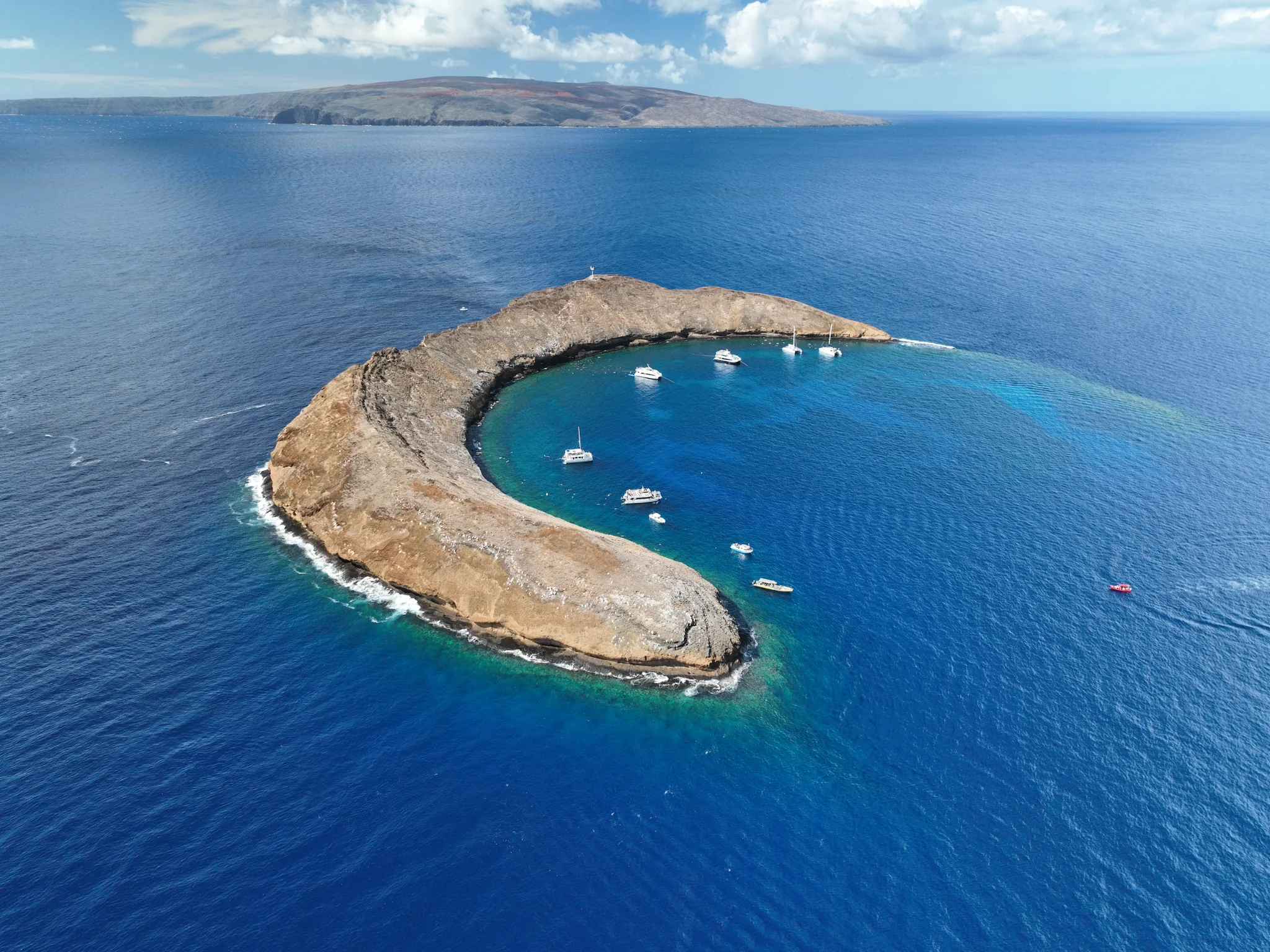
A proposed 100-point framework for documented care of Molokini. The criteria draw on DAR and DLNR rules and guidance, with additional Friends of Molokini standards. This is not a DLNR rating, certification or endorsement. No operator has been assigned a score.
100 points. Six areas of care.
These are proposed Friends of Molokini weights. Legal requirements are identified separately and must be resolved before a positive designation.
30POINTS
Reef and mooring care
Prevent direct physical contact with living habitat. Legal prohibitions are eligibility requirements; the points below assess documented practice and prevention.
View the four checks & evidence
Check 1 — During every sampled visit, the vessel uses authorized mooring procedures, avoids anchoring in the MLCD and does not secure equipment to living coral; applicable mooring authorization and time rules are verified.
Check 2 — Before each sampled visit, the crew records a mooring-line and attachment inspection and has a documented procedure to leave or relocate if the available equipment is unsafe.
Check 3 — On every sampled trip, guests receive and demonstrate a practical briefing on flotation, fin clearance and securing equipment before entering the water.
Check 4 — Observers document active guide supervision and corrective assistance for reef contact; incident records show any contact event, response and follow-up without concealing failures.
Evidence to review
Current vessel permit and mooring authorization
Independent onboard or in-water observation on three visits
Time-stamped arrival/departure and mooring records
Crew checklists, briefing and incident records
Four equally weighted checks. Each check is Pass, Observed failure, or Not assessed. Publish category points only after all four are assessed; category points = weight × passed checks ÷ 4.
Reduce avoidable disturbance while preserving the captain’s responsibility for safety. No arbitrary legal decibel threshold is implied.
View the four checks & evidence
Check 1 — Independent observations document slow-no-wake operation within the Molokini day-use mooring area; safe-navigation exceptions or unusual maneuvers are recorded for review.
Check 2 — A dated maintenance record covers propulsion, exhaust and abnormal vibration/noise, with defects corrected before continued routine use.
Check 3 — The operator has and follows a procedure to avoid unnecessary revving and avoidable idling where safe; the captain records safety-related reasons for departures from that procedure.
Check 4 — On sampled visits, the operator avoids amplified entertainment directed across the crater and teaches guests to avoid disruptive noise; necessary safety announcements remain permitted.
Evidence to review
Independent vessel-operation observations with location/time
Maintenance and defect-resolution records
Written idling and sound practices plus crew interview
Hydrophone data only if collected under a published comparable protocol
Four equally weighted checks. Each check is Pass, Observed failure, or Not assessed. Publish category points only after all four are assessed; category points = weight × passed checks ÷ 4.
Prevent releases, retain evidence of disposal, and respond promptly to loss or spills. Debris of unknown origin is not charged to an operator.
View the four checks & evidence
Check 1 — Secured waste containers and pre-departure loose-item checks are present and used on all sampled visits.
Check 2 — The operator shows an appropriate wastewater retention/disposal procedure and matching disposal or service records; sampled operations follow it and applicable discharge requirements.
Check 3 — The vessel carries maintained spill-response materials, and crew demonstrate the reporting and response procedure in an audit interview.
Check 4 — The operator records witnessed accidental losses or releases, promptly takes safe corrective action and preserves the relevant evidence; a complete incident log or an explicit nil return covers the audit period.
Evidence to review
Direct inspection of bins, wastewater arrangements and spill kit
Wastewater service/disposal records appropriate to vessel design
Training records and crew demonstration
Dated incident log, retained images and corrective action
Four equally weighted checks. Each check is Pass, Observed failure, or Not assessed. Publish category points only after all four are assessed; category points = weight × passed checks ÷ 4.
Protect animals from pursuit, feeding, handling and crowding. Species rules and recommendations must be labeled correctly.
View the four checks & evidence
Check 1 — All sampled briefings state no feeding, chasing or handling and correctly distinguish wildlife distance rules from recommended viewing distances.
Check 2 — Independent observations document no deliberate pursuit, feeding, handling or crowding, with prompt crew intervention when guests need redirection.
Check 3 — The crew demonstrates a written response procedure for an animal that approaches the group, entanglement or a distressed animal; the procedure prioritizes space and appropriate reporting.
Check 4 — The operator documents a guide-supervision plan suited to conditions and participant ability and follows any ratio or supervision requirements actually present in its current permit.
Evidence to review
Briefing observation and dated training materials
In-water audit observations
Crew scenario interview
Current permit conditions and trip supervision plan
Four equally weighted checks. Each check is Pass, Observed failure, or Not assessed. Publish category points only after all four are assessed; category points = weight × passed checks ÷ 4.
Make claims checkable and separate measured performance from marketing.
View the four checks & evidence
Check 1 — The operator supplies a current vessel-specific permit and relevant attachments, with authority and expiry verified and appropriate public fields disclosed.
Check 2 — The operator supplies evidence of required Molokini Use Log submissions for the assessment period; personal passenger information is removed.
Check 3 — The operator permits independent sampled observations and publishes the vessel, period, number of visits, assessed checks, unresolved gaps and reviewer conflicts.
Check 4 — The operator retains an accessible correction contact and provides dated responses and corrective actions for substantiated audit findings.
Evidence to review
Current authorizations and submission receipts
Redacted trip/use records
Published audit summary and evidence register
Correction and response log
Four equally weighted checks. Each check is Pass, Observed failure, or Not assessed. Publish category points only after all four are assessed; category points = weight × passed checks ÷ 4.
Explain why this particular place deserves care, using accurate science and attributed cultural material.
View the four checks & evidence
Check 1 — Every sampled trip includes a place-specific explanation of the MLCD, seabird sanctuary and reason for using moorings.
Check 2 — Teaching materials identify at least one primary or official scientific source and distinguish historical findings from live conditions.
Check 3 — Any moʻolelo or Hawaiian-language teaching identifies its source or cultural reviewer and avoids presenting an unattributed modern retelling as a single definitive tradition. If no cultural material is offered, document that fact and mark this check as meeting its limited requirement to avoid unsupported cultural claims; this does not certify cultural teaching quality.
Check 4 — The briefing gives guests practical ways to prevent disturbance and explains how to report a problem accurately, without pressuring guests to promote or donate to the operator.
Evidence to review
Observed briefings on all sampled visits
Dated education materials and citations
Attribution or cultural review record when cultural material is used
Guest-facing reporting instructions
Four equally weighted checks. Each check is Pass, Observed failure, or Not assessed. Publish category points only after all four are assessed; category points = weight × passed checks ÷ 4.
Each future row will identify the vessel, legal operator, audit period, evidence coverage and review status.
Operator / vessel
Permit verification
Evidence coverage
Stewardship score
Assessment date
Assessments have not started. No business has been assigned a score or rank. Rows will be published only after vessel identity and current authorizations have been checked. Missing evidence is not a zero.
Authorization gate — Verify the operator’s identity, the particular vessel, current DAR use permit and applicable DOBOR authorization. An unavailable record is “permit verification pending,” not an allegation of unlicensed operation. No overall score is issued until this gate is resolved.
Current-conditions gate — Inspect the actual current permit and attachments. Mandatory permit terms must be met before a positive stewardship designation; historical FAQ language alone does not establish the present condition.
Serious-incident gate — A substantiated serious violation or reef-damaging incident prevents a positive designation until independently reviewed and corrective action is verified. Distinguish an official final finding from corroborated observational evidence. A complaint or ambiguous camera image alone does not establish a violation.
Fair-process gate — Give the operator the evidence, a meaningful response period and independent review before publishing an adverse finding. A disputed or incomplete case is labeled “review pending,” not silently converted into a zero.
Completeness gate — All 24 checks must be assessed and all gates resolved before a numeric overall score or comparative rank is published. A material serious-incident or fair-process review suppresses the current score and rank until resolved; display the review status instead.
How the assessment works
The weights are a proposed Friends of Molokini editorial framework, not values prescribed by DAR: reef/mooring care 30, quiet operation 20, waste prevention 20, wildlife care 15, monitoring 10 and education 5. Direct habitat protection receives the largest share; no donation or advertising purchase earns points.
The unit of assessment is the named vessel and its operating entity. Brand names, permit holders and vessels must be distinguished. Do not substitute one audited vessel for an entire fleet, and do not rank fleet averages unless vessel coverage is complete and comparable.
An initial assessment requires at least three independently observed full visits on different dates within a 90-day period, together with relevant permit, training, maintenance and operational records. Observations should include approach, mooring, briefing, in-water supervision and departure. This is a minimum pilot protocol, not a statistically representative census of all operations. The independent reviewer selects visits from the ordinary operating schedule rather than accepting operator-selected showcase trips. Comparative rankings require the same protocol version, assessment window and sampling basis; unequal or selectively collected samples are reported without comparative rank.
Each category has four equally weighted checks. A check passes only when its specified records and observations support it throughout the sampled evidence. A verified failure is a failed check. Missing, inaccessible, conflicting or insufficient evidence is “not assessed”; it never earns zero by default.
Category points = category weight × passed checks / 4. Once all checks are assessed and gates are resolved, add the category points for a total out of 100 and display to at most one decimal. Publish the underlying passed checks and sample size; the numerical precision is not a claim of ecological certainty.
Publish audit dates, observer independence, number of trips, relevant conditions, evidence coverage, unresolved findings and links to permissible supporting records. Remove passenger names and private personal information. Safety-related actions must be assessed in their actual context.
All scores expire 180 days after the last qualifying observation, or at permit expiry, whichever comes first. Review records quarterly and reopen material substantiated incidents promptly. Display expired assessments as historical, without a current badge.
A score describes practices observed over a stated period. It does not prove the absence of every incident, measure total ecosystem damage, or establish which business is responsible for regional warming or debris of unknown origin.
Passenger count, vessel capacity, vessel-hours and visit frequency should be reported as context. Do not automatically reward a small vessel or penalize a large one. Ecological intensity and total exposure require evidence, and the 2010 survey confounded activity type with vessel size.
A camera can support time/location and visible vessel activity when identification is reliable. It cannot by itself prove underwater reef contact, species harassment, permit validity, wastewater composition or underwater noise. Uncertain identification remains unassigned.
Before a launch of rankings, publish the final protocol, train independent observers and pilot it for consistent scoring. Changes to criteria require a versioned explanation and prospective application so operators are compared under the same method.
Corrections, responses and appeals
Give the operator at least 14 calendar days to review the proposed factual findings and supply corrections before first publication of an adverse finding. Extend where necessary to obtain a material official record.
An independent reviewer who did not make the original finding decides the correction request. Record the evidence considered, outcome, date and reason, while redacting personal information.
Allow a public response alongside a disputed finding. Correct factual errors promptly, preserve a dated change log and remove a provisional restriction once the stated issue is resolved.
A verified improvement can trigger a new observation and reassessment; payment, membership, advertising or favorable publicity cannot accelerate a score change.
Independence and conflicts
Publish the website’s ownership, funding and any commercial relationships with tourism businesses before operator ratings begin.
Anyone with an ownership, employment, close financial or family connection to a rated business must recuse from its evidence assessment and appeal. A commercial operator involved in Friends of Molokini must not set or approve its own score.
Use an independent review panel for competitive comparisons and appeals. Reviewers with a material financial or competitive interest must recuse from assessment and appeal decisions concerning both affiliated and competing businesses; disclose the conflict and replacement reviewer.
Keep fundraising, advertising, memberships and referral arrangements separate from evaluation. No paid placement may appear as an earned stewardship result.
Publish reviewer names or accountable institutional affiliations, relevant qualifications and conflict declarations; protect passenger and individual crew privacy.
Reading assessment labels
Not yet assessed
No completed audit. No score, badge or comparative rank.
Permit verification pending
Current vessel authorization has not yet been independently established. This is not a finding of unlawful operation.
Assessment incomplete
Some evidence exists, but one or more checks or gates remain unresolved. Show evidence coverage without an overall score.
Assessed
All checks assessed, gates resolved; show numerical result, dates and evidence coverage. Avoid unsupported labels such as “reef safe.”
Review pending
A material finding requires independent review and an operator response; positive designation temporarily withheld without presuming a violation.
Assessment expired
The validity period or permit has ended. Historical results remain dated and are not presented as current.
Proposed protocol, version 1. Operator cards remain unranked and labeled “Not yet assessed” until current permits, comparable audit evidence and the independent review process are in place. A current verified permit roster must be obtained before presenting a list as exhaustive. The scorecard is a Friends of Molokini initiative; it does not imply government endorsement.